10 Best Compressor Plugins for Mixing in 2026
TL;DR: FabFilter Pro-C 2 is the community’s consensus pick for an all-purpose professional compressor in 2026 — but TDR Kotelnikov and Rough Rider 3 deliver legitimate results at zero cost. This guide covers the top free and paid compressor plugins for mixing, selected on community evidence and developer documentation, not hype.
Quick Picks at a Glance
| Plugin | Price | Best For | Get It |
|---|---|---|---|
| FabFilter Pro-C 2 | $179 | All-purpose mixing and mastering | Official Site |
| Waves SSL G-Master Buss | ~$29.99 | Mix bus glue and cohesion | Official Site |
| Klanghelm DC8C | €21 | Character compression with depth | Official Site |
| TDR Kotelnikov | Free | Transparent bus and mastering compression | Free Download |
| Rough Rider 3 | Free | Aggressive drums and sidechain effects | Free Download |
| Waves API 2500 | ~$29.99 | Punchy, forward-hitting bus compression | Official Site |
Introduction
Here is something the plugin marketing industry does not want you to think about: TDR Kotelnikov, a compressor that costs nothing, shows up in direct comparisons with mastering-grade plugins costing hundreds of dollars on KVR Audio’s forums — and community members consistently report that meaningful differentiation is harder than expected. The best compressor plugins for mixing in 2026 are not always the most expensive ones. But the expensive ones solve specific problems the free ones cannot. Understanding that distinction is the actual skill, and most “best compressor” roundups skip it entirely.
Compressor plugins divide into two practical categories: transparent dynamics processors that move gain without leaving an audible fingerprint, and character compressors that add tonal color, harmonic saturation, or the behavioral signatures of specific vintage hardware. A professional mix typically uses both. A transparent compressor on the stereo bus manages overall dynamics without introducing artifacts; character compressors on drums, bass, and vocals shape the sound while controlling levels. Using one type for everything is the most common compressor mistake in bedroom production, and it is why many mixes sound controlled but flat.
This guide covers ten compressor plugins selected on community consensus across r/audioengineering, r/mixingmastering, KVR Audio, and Gearspace, supported by verified developer documentation. Every claim about sound character is sourced to that consensus or to published specs — not personal use. The focus is producers who are past the tutorial stage and want honest, backed-up reasoning.
Industry Standards: Paid Compressors Worth Their Price
FabFilter Pro-C 2 — The one compressor every serious forum thread points to
- Developer: FabFilter
- Price: $179
- Platforms: Windows, macOS
- Formats: VST, VST3, AU, AAX
FabFilter Pro-C 2 is not the most aggressively marketed compressor in the plugin world. It is the one that survives the marketing cycle and remains the recommendation when producers ask “what should I actually buy” across r/audioengineering, Gearspace, and KVR. FabFilter’s developer documentation confirms that its eight compression styles — Clean, Classic, Opto, Vocal, Mastering, Bus, Punch, and Pumping — use distinct internal algorithms with different detector and gain reduction behaviors, not labeled variations of a single circuit. The community’s consistent description of moving between modes as “clearly audible” aligns with this architecture.
The visual interface — particularly the real-time gain reduction display and interactive attack/release curve — is cited repeatedly in educational content as the reason Pro-C 2 has become a default teaching tool for understanding what compression actually does to audio. Forum consensus frames it as the last compressor many producers buy, not a stepping stone, because its versatility makes a separate collection unnecessary.
Best for: Vocals, mix bus, mastering, producers who want one premium plugin that covers every scenario without compromise.
Waves SSL G-Master Buss Compressor — Decades of mix bus evidence behind one plugin
- Developer: Waves Audio
- Price: From $29.99 (frequent sales)
- Platforms: Windows, macOS
- Formats: VST, VST3, AU, AAX
The SSL 4000 G bus compressor is one of the most analyzed pieces of mixing hardware in recorded music history. Waves’ plugin emulation has been a reference implementation for more than two decades, and its longevity in a market that constantly introduces alternatives is itself a community signal. The behavior producers and educators focus on is the program-dependent release: the compressor adapts its release speed based on the complexity of the incoming signal. Developer documentation positions this as a core design principle modeled from the original hardware, and r/mixingmastering consistently describes the result as “glue” — the effect where individual mix elements begin breathing and moving together rather than sitting in isolation.
Waves’ aggressive sale cadence regularly drops this plugin below $30. For producers moving from default DAW bus processing toward deliberate mix bus compression, the value proposition is among the strongest in this category.
Best for: Stereo mix bus, drum bus, any application requiring the classic SSL program-dependent cohesion response.
→ Get Waves SSL G-Master Buss Compressor
Klanghelm DC8C — More compressor than the price has any right to include
- Developer: Klanghelm
- Price: €21 (paid full version; free limited version available)
- Platforms: Windows, macOS, Linux
- Formats: VST, VST3, AU, AAX
Klanghelm is a developer that KVR Audio’s community consistently surfaces in threads about undervalued plugins. DC8C’s advanced panel — which exposes sidechain filtering, inter-channel crosstalk, and topology switching — contains features that would command a significantly higher price from other developers. Developer documentation describes the topology options as modeling different internal gain reduction element behaviors, and community discussions confirm the modes produce audibly distinct results in coloration and transient shaping. The free version (DC8C3) provides core compression without the advanced routing and style controls.
For producers who prioritize routing depth and tonal range over surface-level aesthetics, DC8C is the consistent answer on budget-focused threads across forums that have been tracking the plugin for years.
Best for: Tracking sessions, parallel compression, complex sidechain routing, producers who want professional-grade flexibility at minimal cost.
Free Essentials: Zero Budget, Zero Compromise
TDR Kotelnikov — The free compressor professionals keep reaching for
- Developer: Tokyo Dawn Labs
- Price: Free (Gentleman’s Edition: €49)
- Platforms: Windows, macOS, Linux
- Formats: VST, VST3, AU, AAX
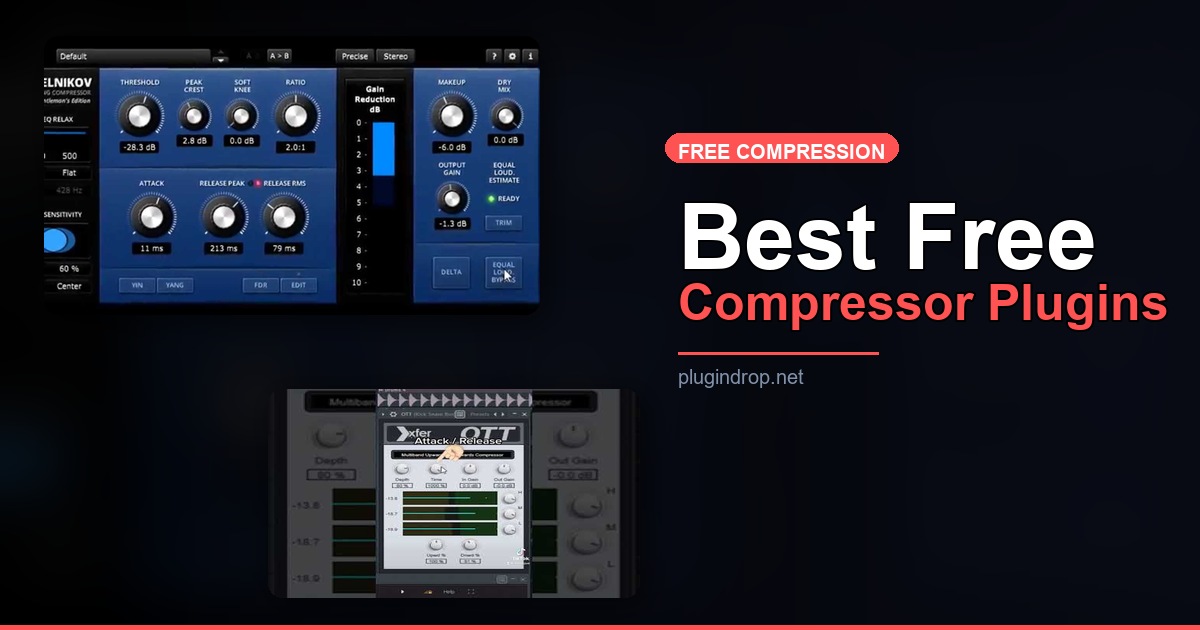
TDR Kotelnikov’s standing on KVR Audio is documented across years of forum threads: it regularly appears in “best compressor under $X” discussions regardless of what X is, including comparisons with plugins costing multiples of its price. Developer documentation describes it as a precision wideband dynamics processor built around a high-quality detector with inter-sample peak sensing and low-distortion gain reduction — the technical specification profile of a mastering tool. The community’s consistent characterization is compression that does not announce itself: gain reduction that happens cleanly, without artifacts, harmonic coloration, or unintended pumping behavior.
The free version is complete for mixing and mastering work. The Gentleman’s Edition adds mid/side processing and additional oversampling for dedicated mastering applications — useful, but non-essential for most mixing scenarios.
Best for: Mix bus, mastering, any context where the compressor should shape dynamics without drawing attention to itself.
→ Download TDR Kotelnikov Free
Rough Rider 3 — Free, fast, and designed to be heard
- Developer: Audio Damage
- Price: Free
- Platforms: Windows, macOS
- Formats: VST, VST3, AU, AAX
Rough Rider 3 exists for a specific purpose: compression that can be heard and felt, not hidden. Developer documentation positions it explicitly as a character compressor for drums and electronic music, built around audible gain reduction behavior rather than transparency. The r/edmproduction community has documented it as a default recommendation for parallel drum compression, where the goal is pumping, breath, and aggression — not controlled, invisible dynamics. The built-in mix knob for parallel blending and the highpass sidechain filter are features that cost money in competing plugins and are included here without conditions.
This plugin does one thing well and does not pretend to do anything else. For producers who want obvious, colorful gain reduction on drums and synths at no cost, the community’s recommendation consistently leads here.
Best for: Parallel drum compression, sidechain pumping effects, electronic and hip-hop production.
Worth Upgrading To (Paid Options)
FabFilter Pro-C 2 — When one transparent and one character compressor is no longer enough
- Developer: FabFilter
- Price: $179
- Why upgrade: TDR Kotelnikov handles transparent bus compression at a high level, and Rough Rider 3 covers aggressive drum character compression. What Pro-C 2 adds is the ability to do both — and every mode between — from a single plugin without switching tools mid-session. For producers doing client work or commercial mixing where session consistency and per-track flexibility matter, the eight algorithm modes, mid/side processing, and real-time visual feedback eliminate the need for a compressor collection.
Waves API 2500 — A different register of bus compression the SSL cannot replicate
- Developer: Waves Audio
- Price: From $29.99 (frequent sales)
- Why upgrade: The SSL G-Master delivers cohesion through its program-dependent release. The API 2500 emulation delivers something the SSL cannot: a forward, punchy character tied to the original hardware’s Thrust high-pass sidechain circuit and its distinct ratio and knee behavior. Gearspace community threads consistently describe these two compressors as complementary rather than competing — the SSL for smoothing and blending, the API 2500 when the drum bus needs to hit harder and sit in front of the mix rather than behind it.
Full Comparison Table
| Plugin | Price | Type | Highlights | CTA |
|---|---|---|---|---|
| FabFilter Pro-C 2 | $179 | Multi-algorithm | 8 distinct styles, visual GR display, M/S | Get It |
| Waves SSL G-Master Buss | ~$29.99 | Hardware emulation | Program-dependent release, classic SSL glue | Get It |
| Klanghelm DC8C | €21 | Multi-style | Topology switching, sidechain filter, Linux | Get It |
| TDR Kotelnikov | Free / €49 GE | Transparent | Inter-sample peak sensing, mastering-grade precision | Download |
| Rough Rider 3 | Free | Character | Parallel mix blend, HP sidechain, aggressive color | Download |
| Waves API 2500 | ~$29.99 | Hardware emulation | Thrust circuit, punchy forward character | Get It |
| Klanghelm DC1A | Free | Simplified character | Minimal controls, smooth coloration, easy parallel use | Free — klanghelm.com |
| Molot (vladg/sound) | Free | Vintage character | Soviet-style coloration, strong KVR community following | Free — vladg/sound |
| TDR Feedback Compressor II | Free | Transparent/feedback | Feedback topology, alternative to Kotelnikov on complex material | Free — tokyodawn.net |
| Density mkIII | Free | Character/bus | Warm bus coloration, Variety of Sound freeware | Free — Variety of Sound |
How to Choose
- If you want one premium compressor to cover all scenarios, FabFilter Pro-C 2 is the community’s answer. Its eight algorithm modes mean you are not compromising — you are choosing between transparent and character compression on a per-track basis from a single plugin.
- If you need mix bus glue and your budget is limited, the Waves SSL G-Master Buss Compressor is the most community-validated hardware emulation for that purpose and often costs under $30 on sale.
- If your budget is zero, use TDR Kotelnikov for transparent compression on buses and full mixes, and Rough Rider 3 for character compression on drums. Both are real production tools with documented track records in professional workflows.
- If you need the drum bus to hit harder and drive forward rather than blend smoothly, the Waves API 2500’s Thrust circuit and API topology provide a character the SSL emulation does not replicate. These two bus compressors are complementary, not interchangeable.
- If you want advanced routing and tonal flexibility under $25, Klanghelm DC8C’s topology switching and sidechain depth place it in a different class from plugins at the same or higher price.
FAQ
What is the best free compressor plugin for mixing in 2026?
TDR Kotelnikov is the top community recommendation for transparent compression on mix buses and full mixes — it handles this role at a level competitive with paid mastering tools. Rough Rider 3 is the secondary pick specifically for drums and electronic music where audible, aggressive compression is the goal. Used together, they cover the two primary compression archetypes without spending anything.
What compressor should I use on the mix bus?
For transparent glue without coloration, TDR Kotelnikov is the free answer; FabFilter Pro-C 2 in Bus or Mastering mode is the paid answer. For character-based bus compression with the classic SSL response, the Waves SSL G-Master Buss Compressor is the most consistently recommended option. The Waves API 2500 is the choice when you want the bus to feel punchy and forward rather than smooth and recessed.
Is FabFilter Pro-C 2 worth $179?
Community consensus across r/audioengineering, Gearspace, and KVR answers yes — but with a specific justification. The argument is not that it sounds better than all competing plugins in every individual use case. It is that its eight algorithm modes eliminate the need to own multiple compressors. A producer who would otherwise purchase a separate transparent bus compressor, an optical vocal compressor, and a VCA drum compressor may spend more than $179 total for less workflow cohesion.
What is the difference between a VCA and an optical compressor plugin?
These terms describe the gain reduction element the compressor circuit is modeled on. VCA (voltage-controlled amplifier) compressors respond quickly and predictably to signal levels, making them standard for drums and bus compression — the Waves SSL G-Master and API 2500 fall into this category. Optical compressors use a light-dependent resistor that produces a slower, more program-sensitive response, typically associated with smooth vocal leveling and acoustic instruments. FabFilter Pro-C 2’s Classic mode models VCA behavior; its Opto mode models optical behavior — both available in the same plugin.
Do I need multiple compressor plugins, or can one cover everything?
One can cover everything if it is sufficiently versatile. FabFilter Pro-C 2 is the community’s primary example of a compressor that handles this. In practice, most producers working across genres end up with at least two: one transparent option for bus and mastering work, and one character option for drums and tracking. For producers starting out, TDR Kotelnikov and Rough Rider 3 together establish this two-compressor workflow at no cost.
Related Guides
- 12 Best Free Compressor VST Plugins in 2026 (Every Style Covered)
- 10 Best Free Delay VST Plugins in 2026 (Tape, Digital, Multi-tap)
- 10 Best Free EQ VST Plugins in 2026 (Mixing & Mastering)
- 15 Best Free Reverb VST Plugins in 2026 (Tested by Producers)
- Best Free Saturation VST Plugins: 2026 Guide
Final Thoughts
FabFilter Pro-C 2 is the best compressor plugin for mixing in 2026 for producers who can make the investment — community consensus on this has been consistent across forums for years, and no alternative has emerged to change it. If the budget is not there yet, TDR Kotelnikov and Rough Rider 3 together cover the two compression roles that matter most in a modern mix, and neither is a consolation prize. Start with the free tier, understand what each compressor is actually doing to your audio, and invest in Pro-C 2 when the capability gap becomes audible.
This post contains affiliate links. We may earn a small commission at no extra cost to you.
This post contains affiliate links. We may earn a small commission at no extra cost to you.