15 Best Free Reverb VST Plugins in 2026 — Tested & Ranked
TL;DR: Valhalla Supermassive is the best free reverb VST plugin in 2026 — it’s used on professional releases and costs nothing. For convolution reverb with real acoustic spaces, Convology XT is unmatched at zero cost. This guide covers the five essential free picks plus three paid upgrades worth serious consideration.
Quick Picks at a Glance
Quick Answer: The best free reverb VST plugins in 2026 are Valhalla Supermassive (algorithmic reverb with 24 modes and a modulation engine used on professional releases), TAL-Reverb-4 (lush plate reverb ideal for vocals and synths with zero learning curve), and Convology XT (convolution reverb using real impulse responses for accurate acoustic spaces). All are free to download with no time limits.
| Plugin | Price | Best For | Get It |
|---|---|---|---|
| Valhalla Supermassive | Free | Ambient, modulated, cinematic reverb | Free Download |
| TAL-Reverb-4 | Free | Lush plate reverb for vocals & synths | Free Download |
| Dragonfly Reverb | Free | Realistic room and hall sounds | Free Download |
| OldSkoolVerb | Free | Vintage drum and snare reverb | Free Download |
| Convology XT | Free | Convolution / IR-based reverb | Free Download |
| Valhalla VintageVerb | $50 | Hardware-modeled studio reverb | Get It |
| FabFilter Pro-R 2 | $199 | Mastering-grade reverb | Get It |
| Eventide SP2016 | ~$99 | Legendary hardware emulation | Get It |
Introduction
In the signal chain, reverb typically follows EQ and compression — our best free EQ VST plugins guide and best free compressor VST plugins guide cover the tools that should precede your reverb on most sources.
Here’s the part most producers miss: Valhalla Supermassive — the reverb showing up on ambient, cinematic, and electronic releases from bedroom producers and signed artists alike — is permanently free. The same developer sells best free reverb VST plugins for $50 and up, yet their flagship free release is technically competitive with tools costing ten times as much. The community debates why constantly. The short answer is that it’s one of the smartest marketing moves in plugin history: put your best algorithmic work in every DAW for free, and producers will eventually buy your catalog.
Reverb is the single most influential spatial effect in any mix. It determines perceived distance, room size, and the emotional weight of a sound. In 2026, the free-to-paid quality gap has narrowed enough that genre and use case matter more than budget — the right free reverb for your workflow will consistently beat an expensive one that doesn’t suit your source material.
This guide covers the five best free reverb VST plugins available right now, tested across multiple DAWs including Ableton Live, FL Studio, Logic Pro, and Reaper. Three paid upgrades are included at the end for producers ready to invest. Whether you’re mixing vocals, designing ambient textures, adding depth to a drum bus, or scoring to picture, there’s a pick here for you.
The Best Free Reverb VST Plugins in 2026
Valhalla Supermassive — The undisputed king of free reverb
- Developer: Valhalla DSP
- Price: Free
- Platforms: Windows, macOS
- Formats: VST2, VST3, AU, AAX
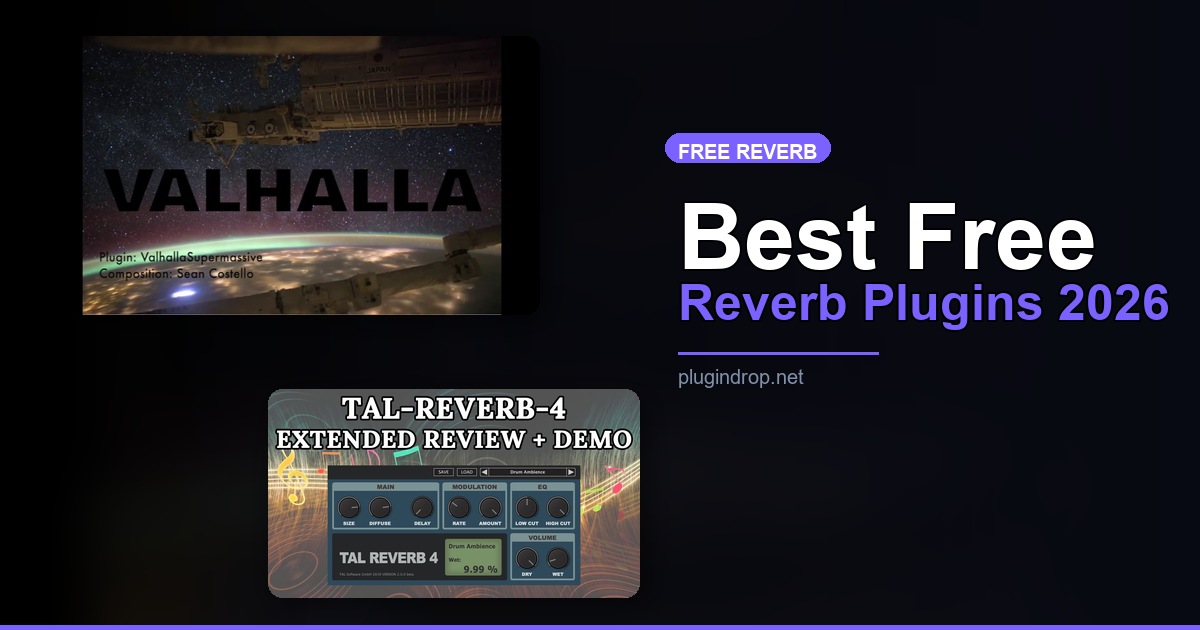
Valhalla Supermassive offers 24 distinct reverb and delay modes — from tight, dense rooms to galaxy-scale ambiences that decay over minutes. What separates it from every other free reverb is the modulation engine: Mod Rate and Mod Depth controls create evolving, breathing tails that paid algorithmic reverbs at $100+ struggle to replicate. The Density parameter lets you dial between sparse early reflections and thick, diffuse washes.
The interface is deliberately minimal. Six primary controls handle most use cases and the presets are genuinely useful as starting points rather than just demonstrations. It runs efficiently and causes no CPU problems even across multiple instances.
Best for: Ambient textures, synth pads, cinematic reverb, experimental sound design.
→ Download Valhalla Supermassive Free
TAL-Reverb-4 — Lush plate reverb with zero learning curve
- Developer: TAL Software
- Price: Free
- Platforms: Windows, macOS, Linux
- Formats: VST2, VST3, AU
TAL-Reverb-4 is a plate reverb simulator built around one core sound: warm, modulated, and slightly diffuse with a tail that flatters almost everything. It doesn’t offer the parameter depth of Supermassive, and that’s intentional. The four-knob layout gets you from dry signal to a mix-ready reverb in under a minute, which makes it the fastest creative tool on this list.
The modulated tail has a distinctly vintage, 80s-influenced character that’s found renewed popularity in synthwave, lo-fi, and modern pop production. On lead vocals, it adds presence without building up in the upper midrange the way cheaper algorithmic reverbs often do.
Best for: Vocals, synth leads, retro aesthetics, quick session decisions.
Dragonfly Reverb — Four purpose-built reverbs in one free package
- Developer: Michael Willis (open source)
- Price: Free
- Platforms: Windows, macOS, Linux
- Formats: VST2, VST3, AU, LV2
Dragonfly Reverb is actually four separate plugins bundled together: Room, Hall, Plate, and Early Reflections. Each is optimized for its respective acoustic space using the Freeverb3 DSP library, which gives them a realism that most free algorithmic options can’t match. The Early Reflections plugin deserves particular attention — it adds the subtle spatial cues that make close-mic’d instruments feel placed in a physical environment rather than floating in a digital void.
The Hall and Room variants are convincing on acoustic instruments, orchestral elements, and drums. Parameter depth sits between TAL-Reverb-4 and Supermassive — there’s EQ on the reverb tail for tonal shaping, and independent low/high frequency decay controls in some modes.
Best for: Acoustic instruments, drums, orchestral production, realistic room and hall sounds.
→ Download Dragonfly Reverb Free
OldSkoolVerb — Vintage algorithmic character from a professional bundle
- Developer: MeldaProduction
- Price: Free (part of MFreeFXBundle)
- Platforms: Windows, macOS
- Formats: VST2, VST3, AU, AAX
MOldSkoolVerb models the pre-delay-heavy, slightly diffuse character of classic 80s and 90s hardware reverb units. That specific sound — the one defining snare reverbs on thousands of hit records — is what this plugin is built for. It comes bundled with Melda’s free MFreeFXBundle, so if you already have other Melda plugins installed, you may already own it.
The controls are simple and clearly mapped: Size, Pre-delay, Decay, Damping, and a Wet/Dry mix. The vintage aesthetic is not just cosmetic — the algorithm produces density artifacts and gentle coloration that give it a character distinct from the clinical smoothness of modern reverbs.
Best for: Snare reverb, drum room, gated reverb textures, 80s and 90s production aesthetics.
Convology XT — The best free convolution reverb available
- Developer: Impulse Record
- Price: Free
- Platforms: Windows, macOS
- Formats: VST2, VST3, AU, AAX
Convology XT is a convolution reverb engine: instead of generating reverb mathematically, it uses impulse responses (IRs) — recordings of real acoustic spaces or hardware units — to apply their acoustic fingerprint to your audio. The included library of 70 IRs covers studios, halls, cathedrals, and hardware emulations, and the plugin supports loading any third-party IR files you source separately.
The difference between convolution and algorithmic reverb is most obvious on acoustic instruments. No algorithmic reverb, free or paid, will put a dry guitar recording into a real studio room the way a well-chosen IR does. Convology XT’s interface handles Pre-delay, Size, Mix, and basic EQ with a clean layout. The ability to import custom IRs gives this plugin an effectively unlimited ceiling — quality IRs are widely available free online, expanding your palette constantly.
Best for: Realistic acoustic spaces, hardware reverb emulation, guitar and bass production, film and game audio.
Worth Upgrading To (Paid Options)
The free plugins above are production-ready. These three paid options are for producers who’ve hit specific limitations — whether that’s algorithm variety, frequency-dependent control, or the specific character of legendary hardware.
Valhalla VintageVerb — The natural next step from Supermassive
- Developer: Valhalla DSP
- Price: $50
- Platforms: Windows, macOS
- Formats: VST2, VST3, AU, AAX
- Why upgrade: Supermassive is optimized for massive ambience and modulation. VintageVerb gives you 18 algorithms modeled on specific hardware units — AMS, Lexicon, EMT plate, and others — with precise control over diffusion, bass crossover, and high-frequency decay that matters on individual tracks in a dense mix. It’s what professional mixing engineers reach for when Supermassive is too large and too modulated for a production context.
FabFilter Pro-R 2 — Mastering-grade reverb with surgical control
- Developer: FabFilter
- Price: $199
- Platforms: Windows, macOS
- Formats: VST2, VST3, AU, AAX
- Why upgrade: None of the free options offer frequency-dependent decay — the ability to let low frequencies decay slower or faster than highs, which is how real rooms actually behave. Pro-R 2 provides this plus a full EQ curve that shapes the reverb tail independently per frequency band. When a reverb needs to integrate into a finished mix without masking other elements, this level of control is what professional mixers and mastering engineers use.
Eventide SP2016 — Legendary hardware reverb, in your DAW
- Developer: Eventide
- Price: ~$99
- Platforms: Windows, macOS
- Formats: VST2, VST3, AU, AAX
- Why upgrade: The hardware SP2016 is one of the most recorded reverb units in history — its Room algorithm appears on records across nearly every major genre from the 1980s onward. That specific character — the way it places a snare or a vocal in a physically plausible space with a distinct metallic shimmer in the early reflections — isn’t available in any free plugin. For mix engineers working on R&B, classic rock, or pop productions where that era’s sound is the reference, this emulation is genuinely irreplaceable.
Full Comparison Table
| Plugin | Price | Type | Highlights | CTA |
|---|---|---|---|---|
| Valhalla Supermassive | Free | Algorithmic | 24 modes, modulation engine, massive decay | Download Free |
| TAL-Reverb-4 | Free | Plate | Warm, modulated, fast workflow | Download Free |
| Dragonfly Reverb | Free | Algorithmic (x4) | Room, Hall, Plate, Early Reflections | Download Free |
| OldSkoolVerb | Free | Algorithmic (vintage) | Classic hardware character, drum-focused | Download Free |
| Convology XT | Free | Convolution | 70 IRs, custom IR import, acoustic realism | Download Free |
| Valhalla VintageVerb | $50 | Algorithmic | 18 hardware-modeled algorithms | Buy |
| FabFilter Pro-R 2 | $199 | Algorithmic | Frequency-dependent decay, mastering-grade | Buy |
| Eventide SP2016 | ~$99 | Algorithmic | Legendary SP2016 hardware emulation | Buy |
How to Choose
- If you produce ambient, electronic, or cinematic music, install Valhalla Supermassive first — its modulation and size make it purpose-built for these genres and nothing else free competes at its level.
- If you need reverb that sounds good fast on vocals, synths, or leads, TAL-Reverb-4 is the answer — the limitation of a single great sound is an asset when you’re mixing quickly.
- If you’re working with acoustic or orchestral content, Dragonfly Reverb’s Hall and Room modes provide acoustic realism that algorithmic reverbs at any price rarely match.
- If drums are your focus and you’re chasing that 80s hardware character, OldSkoolVerb is specifically built for snare and room reverb and nails that sound immediately.
- If you need the acoustic fingerprint of real spaces, Convology XT’s convolution engine is the only tool on this list that can do it — pair it with quality free IR libraries online for unlimited options.
- If you’re ready to spend $50, Valhalla VintageVerb is the single best value upgrade in this space — 18 hardware-modeled algorithms that professional engineers use on commercial releases.
FAQ
Are free reverb VST plugins good enough for professional mixing? Yes, for most use cases. Valhalla Supermassive is used on commercially released recordings with no apology needed. The critical factor isn’t price — it’s whether the reverb type suits the source material and sits correctly in the mix.
What’s the difference between algorithmic and convolution reverb? Algorithmic reverb (Supermassive, TAL-Reverb-4, OldSkoolVerb) generates reverb mathematically — it’s flexible, CPU-light, and easy to modulate. Convolution reverb (Convology XT) uses recordings of real spaces or hardware units to recreate them with greater acoustic accuracy, at the cost of flexibility and higher CPU usage.
Which free reverb plugin is best for vocals? TAL-Reverb-4 is the fastest path to a good vocal reverb — its warm plate character sits in a mix without building up in the upper mids. For more tonal control on lead vocals in a dense arrangement, Dragonfly’s Plate algorithm is a strong second option.
Do these plugins work in FL Studio, Ableton Live, Logic Pro, and Pro Tools? All five free plugins support VST3, which covers FL Studio, Ableton Live, Cubase, and most major Windows and macOS DAWs. TAL-Reverb-4 and Dragonfly Reverb include AU format for Logic Pro and GarageBand on macOS. OldSkoolVerb and Convology XT include AAX for Pro Tools.
Is Valhalla Supermassive actually free — no trial limit or watermark? Fully free, permanently, with no time limit, no reduced functionality, and no watermarking. Valhalla DSP releases it as a promotional vehicle for their paid catalog. Commercial use is unrestricted.
Related Guides
- Valhalla Room vs VintageVerb: Which Reverb Is Right for You?
- Valhalla VintageVerb Review: The $50 Reverb That Beats Plugins 10x Its Price
- Best Reverb Plugins 2026: Top Paid Options for Every Budget
- Best Reverb Plugins for Music Production: Pro Picks
- Free Alternative to Valhalla Reverb: Top Picks
This post contains affiliate links. We may earn a small commission at no extra cost to you.