12 Best Reverb Plugins for Music Production in 2026 (Free & Paid)
TL;DR: Valhalla VintageVerb at $50 is the most-recommended algorithmic reverb under $100 across producer communities — it punches well above its price class and the community consensus on this is unusually strong. FabFilter Pro-R 2 is the precision choice for mixing engineers who need frequency-dependent decay control. If budget is a constraint, Valhalla Supermassive is free and genuinely holds its own against paid options for ambient and atmospheric production.
Quick Picks at a Glance
| Plugin | Price | Best For | Get It |
|---|---|---|---|
| Valhalla VintageVerb | $50 | Mixing — all genres, all sources | Get It (Official) |
| FabFilter Pro-R 2 | €179 | Precision mixing, decay EQ | Get It (Official) |
| Eventide SP2016 | $99 | Vintage hardware character | Get It (Official) |
| Arturia Rev PLATE-140 | ~$49 standalone | Plate reverb, vocals, drums | Get It (Official) |
| Valhalla Supermassive | Free | Ambient, pads, massive tails | Free Download |
| TAL-Reverb-4 | Free | Lush algorithmic reverb | Free Download |
| MConvolutionEZ | Free | Convolution reverb, IR loading | Free Download |
Introduction
Here’s the market anomaly nobody talks about loudly enough: Valhalla VintageVerb — the most-recommended paid reverb across KVR Audio, Gearspace, and r/edmproduction — costs $50. Plugins priced at $200 or $400 don’t consistently beat it in blind listening comparisons documented by those communities. In reverb, high price correlates with features and brand cachet, not necessarily sound quality. Choosing the best reverb plugins for music production in 2026 means understanding that gap.
The market in 2026 divides cleanly into two camps. Precision algorithmic reverbs — like FabFilter Pro-R 2 — offer deep mix integration, frequency-dependent decay shaping, and transparent sound designed to sit in a dense mix. Hardware-character reverbs — Eventide SP2016, Arturia Rev PLATE-140 — chase specific vintage units and their sonic signatures. Both camps have strong free and paid representatives. A producer working solely in free tools is not working at a meaningful disadvantage over someone who hasn’t made deliberate choices in the paid tier.
This guide covers 12 reverb plugins across paid, free algorithmic, and free convolution categories. It’s written for producers who mix their own work — bedroom and semi-pro setups where every dollar spent on software has to justify itself against months of actual use.
Best Paid Reverb Plugins
FabFilter Pro-R 2 — The mixing engineer’s precision instrument
- Developer: FabFilter
- Price: €179
- Platforms: Windows, macOS
- Formats: VST2, VST3, AU, AAX
FabFilter Pro-R 2 is distinguished by a single feature that the Gearspace and r/mixingmastering communities consistently name as its defining advantage: frequency-dependent decay EQ. The low end of a reverb tail can be made to decay faster than the mids and highs, directly solving the most common problem with reverb in busy mixes — low-mid accumulation that muddies the low end of the mix. No free plugin in this guide replicates that feature. The interface visualizes decay shape and EQ simultaneously, which makes mixing decisions fast and non-destructive.
Best for: Mixing engineers, anyone whose reverb regularly conflicts with bass and low-mids.
→ Get FabFilter Pro-R 2 (Official)
Eventide SP2016 — Authentic hardware algorithm from the original manufacturer
- Developer: Eventide
- Price: $99
- Platforms: Windows, macOS
- Formats: VST2, VST3, AU, AAX
The original Eventide SP2016 hardware unit (1982) produced some of the most recognizable snare drum reverbs in recorded music history — the dense, characterful room textures that defined a decade of records. The plugin recreation was developed by Eventide themselves, which matters: these are the original algorithms, not third-party approximations. The KVR community specifically flags the “Stereo Room” mode as the standout — dense, nonlinear, and noticeably different in character from the smooth algorithmic designs in modern plugins. If you’ve tried to replicate vintage 80s mix textures with contemporary reverbs and found something missing, the SP2016 is a significant part of that gap.
Best for: Vintage character work, snare drums, 1980s-influenced mixing aesthetics.
→ Get Eventide SP2016 (Official)
Valhalla VintageVerb — The benchmark for value in reverb
- Developer: Valhalla DSP
- Price: $50
- Platforms: Windows, macOS
- Formats: VST2, VST3, AU, AAX
Valhalla VintageVerb is the most-recommended algorithmic reverb under $100 in producer communities — that’s a statement supported by repeated polling and recommendation threads on KVR, Gearspace, and r/edmproduction, not marketing copy. Developer Sean Costello built 18 reverb modes modeled after 1970s–80s hardware, each with distinct density, pre-delay, and modulation character. The Density control and the Noisy/Color mode variations have become particularly noted by the community for adding musical character without sounding processed. At $50, it represents a value point that community consensus has validated over years of comparative discussion.
Best for: Everything — drums, vocals, guitars, pads. The genre and application range is unusually broad for a single plugin.
→ Get Valhalla VintageVerb (Official)
Arturia Rev PLATE-140 — Physical modeling of an iconic hardware plate
- Developer: Arturia
- Price: ~$49 standalone, or included in Arturia FX Collection
- Platforms: Windows, macOS
- Formats: VST3, AU, AAX
The EMT 140 plate reverb has appeared on studio recordings from Frank Sinatra sessions through present-day sessions in high-end facilities — it’s one of the most recorded-on pieces of hardware in studio history. Arturia’s Rev PLATE-140 uses physical modeling (not impulse response capture) to simulate the plate mechanics: tension, damping, and mic placement. Arturia’s documentation confirms this approach, which they also apply in their synthesizer emulations. The plugin community notes it’s well-suited to vocals and drum rooms where you want warm density without the diffuse wash that can come from longer algorithmic tails.
Best for: Vocals, drum room, any application where classic plate warmth is the target character.
→ Get Arturia Rev PLATE-140 (Official)
Best Free Algorithmic Reverb Plugins
Valhalla Supermassive — The best free reverb in the market
- Developer: Valhalla DSP
- Price: Free
- Platforms: Windows, macOS
- Formats: VST2, VST3, AU, AAX
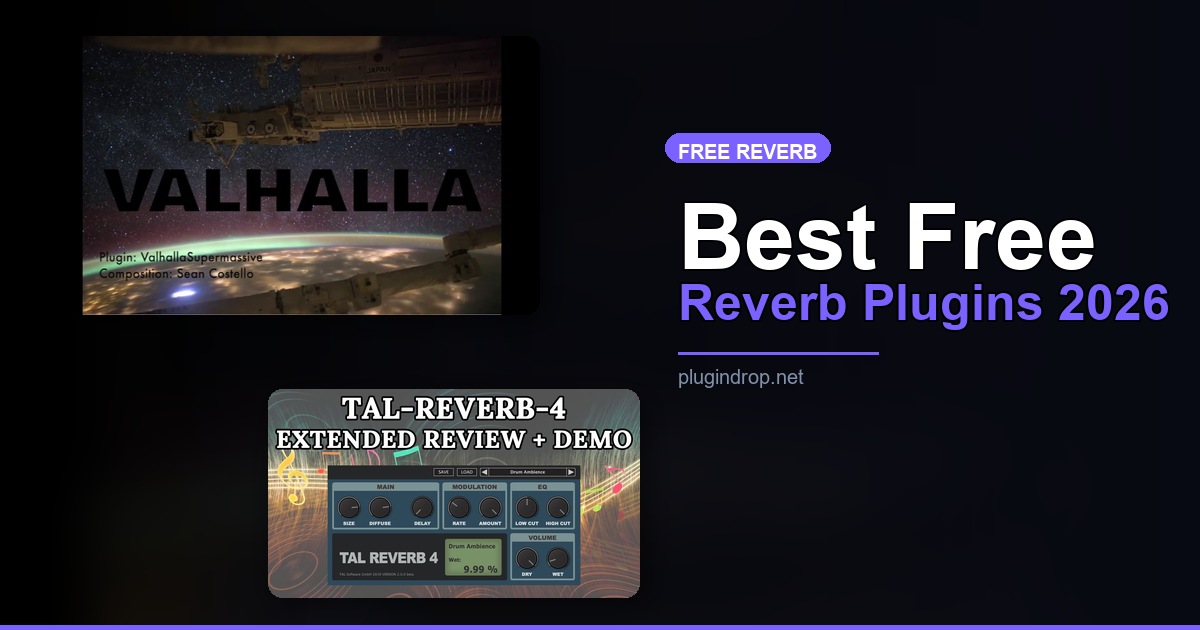
Valhalla DSP released Supermassive as a free tool in 2020 and the community response was immediate — it became the most-recommended free reverb almost overnight and has held that position since. Developer Sean Costello designed it specifically for extreme decay times and high-modulation applications. The community on r/ambientmusic, r/edmproduction, and KVR audio regularly cites it as a first recommendation for pads, drones, post-rock guitar, and any texture requiring large spatial presence. That it comes free from a respected paid developer — with continued updates — remains unusual in the plugin market.
Best for: Ambient music, pads, long reverb tails, experimental and post-rock textures.
→ Download Valhalla Supermassive Free
TAL-Reverb-4 — Dense, lush, and free since launch
- Developer: Togu Audio Line (TAL)
- Price: Free
- Platforms: Windows, macOS, Linux
- Formats: VST2, VST3, AU
TAL Software has a well-established track record with free plugins — their TAL-U-NO-LX Juno emulation and TAL-Chorus-LX are community fixtures. TAL-Reverb-4 carries that reputation into reverb. KVR forum discussions consistently describe it as sounding “expensive” for a free plugin — a dense, dimensional tail rather than the thin or metallic quality common in lower-quality algorithmic designs. The modulation controls work particularly well on synth pads and vocal elements. Linux support via VST3 extends its utility beyond the Windows/Mac ecosystem.
Best for: Pads, vocals, synth leads, any dense mix element requiring dimensional space.
OldSkoolVerb — Transparent and reliable from Voxengo
- Developer: Voxengo
- Price: Free
- Platforms: Windows, macOS
- Formats: VST2, VST3, AU
Voxengo is known for technically precise DSP — their paid plugins like SPAN and Correlometer are professional-grade analysis tools. OldSkoolVerb reflects that lineage: a clean, lightweight algorithmic reverb without the heavy modulation of TAL-Reverb-4 or the extreme tail lengths of Supermassive. KVR users consistently describe it as a “workhorse” free option — reliable, low-CPU, and clean enough that it doesn’t impose color when that’s not what the source material needs. When the goal is transparent ambience rather than character, it’s a regularly cited choice.
Best for: Transparent room ambience, light spatial placement, any source where reverb color is unwanted.
Dragonfly Reverb — Open-source, cross-platform, and surprisingly capable
- Developer: Michael Willis (open source)
- Price: Free
- Platforms: Windows, macOS, Linux
- Formats: VST2, VST3, CLAP, LV2
Dragonfly Reverb is an open-source suite that ships as four separate plugins: Room, Hall, Plate, and Early Reflections. The open-source community has documented that the algorithms draw on well-regarded academic reverb research, and the results reflect that foundation — functional across its intended range without the low-quality digital coloration common in lower-effort free plugins. The standout differentiator is Linux and LV2 support, which makes it the top community recommendation for Linux producers who need quality reverb. Available from the developer’s GitHub repository.
Best for: Linux producers, early-reflections work, general-purpose algorithmic reverb across all platforms.
→ Download Dragonfly Reverb Free
Raum — Three distinct modes, available free from NI
- Developer: Native Instruments
- Price: Free (included in Komplete Start)
- Platforms: Windows, macOS
- Formats: VST3, AAX, NKS
Raum is a genuine Native Instruments plugin — sold individually and also bundled free in their Komplete Start collection. The three modes (Grounded for rooms, Airy for halls, Cosmic for experimental spectral processing) each run distinct diffusion algorithms, not parameter variations on a single engine, per NI’s developer documentation. The Cosmic mode, which produces pitch-shifted and granular reverb textures, is particularly noted in the NI user community for creative applications in electronic music. Installation requires Native Access. For producers already in the NI ecosystem, it integrates cleanly with NKS-compatible controllers.
Best for: Producers in the NI ecosystem, experimental reverb textures, Cosmic mode for ambient and electronic production.
→ Download Raum Free via Komplete Start
Oril River — Underrated free algorithmic reverb
- Developer: Denis Tihanov
- Price: Free
- Platforms: Windows, macOS
- Formats: VST2, VST3
Oril River has maintained consistent presence in KVR Audio’s “freeware gems” discussions across multiple years. Denis Tihanov built a parametric algorithmic reverb with multiple algorithm types — early reflections, hall, room — and an interface that exposes pre-delay, diffusion, and tail controls without excessive complexity. KVR community members frequently place it alongside TAL-Reverb-4 as a free algorithmic option with professional-tier quality — not just passable for free, but useful in contexts where paid options would otherwise be the default. Available directly from the developer and documented extensively on KVR Audio.
Best for: General mixing, producers who want a reliable second free algorithmic reverb alongside Supermassive.
→ Search Oril River on Plugin Boutique
Best Free Convolution Reverb Plugins
MConvolutionEZ — MeldaProduction quality at zero cost
- Developer: MeldaProduction
- Price: Free (part of MFreeFXBundle)
- Platforms: Windows, macOS
- Formats: VST2, VST3, AU, AAX
MConvolutionEZ is included in MeldaProduction’s MFreeFXBundle — a collection of 37 free plugins that the developer actively updates. Convolution reverb uses recorded impulse responses (IRs) of real spaces and hardware processors, making it more acoustically accurate than pure algorithmic approaches for natural-sounding halls, chambers, and plates. MConvolutionEZ ships with bundled IRs and supports loading custom IR files, opening access to the large ecosystem of third-party impulse responses available freely from studios, hardware manufacturers, and acoustic measurement projects. MeldaProduction’s reputation for quality DSP extends to this free tier.
Best for: Realistic acoustic spaces, hardware reverb emulation via IRs, producers wanting to experiment with custom impulse responses.
→ Download MConvolutionEZ Free
Convology XT — Free convolution with a built-in IR library
- Developer: Impulse Record
- Price: Free (with included IR library)
- Platforms: Windows, macOS
- Formats: VST2, AU
Convology XT comes from Impulse Record, a company whose primary business is selling professional impulse response libraries. The free plugin ships with a curated selection of their commercial IRs included — which means the bundled content reflects a commercial IR standard rather than the freeware IR quality common in less-resourced free convolution plugins. The plugin community notes this as its key advantage: the impulse responses included out of the box cover genuine acoustic spaces credibly. Producers exploring convolution reverb for the first time will find the included library above average for a free tool. Available from Impulse Record’s website.
Best for: Convolution reverb with high-quality acoustic space IRs, producers new to IR-based reverb.
→ Download Convology XT Free (Official)
Worth Upgrading To (Paid Options)
Valhalla VintageVerb — The natural next step from free reverb
- Developer: Valhalla DSP
- Price: $50
- Why upgrade: Supermassive’s algorithms are optimized for extreme tail lengths and ambient textures — not the natural-sounding room, hall, and plate reverbs needed in most mix contexts. VintageVerb’s 18 modes were specifically built for mix-ready applications, and the musicality difference in a dense mix is clear from the first session.
→ Get Valhalla VintageVerb (Official)
FabFilter Pro-R 2 — When free options hit their ceiling
- Developer: FabFilter
- Price: €179
- Why upgrade: No free algorithmic reverb offers frequency-dependent decay control — the ability to shorten low-end decay while retaining high-end shimmer. Pro-R 2’s decay EQ directly addresses low-mid buildup in reverb tails, which is the most common engineering problem free reverbs leave unsolved.
→ Get FabFilter Pro-R 2 (Official)
Full Comparison Table
| Plugin | Price | Type | Highlights | CTA |
|---|---|---|---|---|
| FabFilter Pro-R 2 | €179 | Algorithmic | Decay EQ, precision mixing | Get It |
| Eventide SP2016 | $99 | Hardware emulation | Original 1982 algorithms, Stereo Room mode | Get It |
| Valhalla VintageVerb | $50 | Algorithmic | 18 vintage modes, best-value paid | Get It |
| Arturia Rev PLATE-140 | ~$49 | Physical model | EMT 140 plate emulation | Get It |
| Valhalla Supermassive | Free | Algorithmic | Extreme tails, ambient — free from Valhalla | Free Download |
| TAL-Reverb-4 | Free | Algorithmic | Dense, lush, Linux support | Free Download |
| OldSkoolVerb | Free | Algorithmic | Transparent, low-CPU, Voxengo quality | Free Download |
| Dragonfly Reverb | Free | Algorithmic suite | Room/Hall/Plate/ER, LV2/Linux | Free Download |
| Raum | Free | Algorithmic/Spectral | 3 distinct modes, Cosmic for experimental | Free Download |
| Oril River | Free | Algorithmic | Multi-mode, transparent, community-vetted | Free (Denis Tihanov / KVR Audio) |
| MConvolutionEZ | Free | Convolution | Custom IR loading, MeldaProduction quality | Free Download |
| Convology XT | Free | Convolution | Commercial-quality bundled IR library | Free (Impulse Record website) |
How to Choose
- If you produce ambient, drone, or post-rock: Start with Valhalla Supermassive — its extreme decay times and modulation depth are purpose-built for those genres, and it costs nothing.
- If you’re mixing vocals, drums, or guitars in any genre and have $50: Valhalla VintageVerb is the strongest single-purchase recommendation in this list — the community consensus behind it is unusually clear and the price is genuinely anomalous for what it delivers.
- If reverb frequency buildup is muddying your low-mids: FabFilter Pro-R 2’s decay EQ directly solves that specific problem. No free plugin in this list addresses it. If that’s your recurring issue, this is the right tool.
- If you want 1980s hardware reverb character: Eventide SP2016 is the authentic option — Eventide developed the original hardware and the original algorithms. That’s not the case for most “vintage-inspired” reverbs on the market.
- If you’re on Linux: Dragonfly Reverb is the top community recommendation — it’s the only quality algorithmic reverb suite in this list with LV2 and CLAP support.
- If you want convolution reverb for free: MConvolutionEZ gives you IR loading and a functional IR library at no cost. Pair it with freely available third-party impulse responses and the ceiling is high.
FAQ
What’s the difference between algorithmic and convolution reverb? Algorithmic reverbs use mathematical models to simulate acoustic space — they’re flexible, low-latency, and easy to automate. Convolution reverbs use recorded snapshots (impulse responses) of real spaces or hardware units, making them more accurate for realistic spaces but less flexible for creative shaping. Most producers keep both types in their workflow.
Is Valhalla VintageVerb worth $50 for a beginner? The community answer is consistently yes — but build context first. Spend real sessions with Valhalla Supermassive and TAL-Reverb-4 (both free) before purchasing. If you’ve used those and understand what they’re missing for natural-sounding mix reverb, VintageVerb is the right step and $50 is a fair price for years of use.
Can free reverb plugins genuinely compete with paid options? For ambient and creative applications, yes — Valhalla Supermassive competes with plugins costing much more for those specific use cases. For precise mix-ready reverb with frequency control, no: the decay EQ features in Pro-R 2 have no free equivalent. Free wins in creative and experimental territory; paid wins on precision engineering.
What reverb works best on vocals? Community consensus splits between two approaches: plate reverb (Arturia Rev PLATE-140 for classic warm density) and short algorithmic reverb with pre-delay (Valhalla VintageVerb’s Plate or Room modes, pre-delay set to 15–30ms to separate the verb from the dry signal). Both are valid — plate works best for warm, intimate productions; algorithmic with pre-delay works better in dense mixes where you need the vocal to stay present.
Do I need multiple reverb plugins? Most producers settle on two or three: one for general mixing, one for creative/ambient applications, and optionally one convolution reverb for realistic spaces. Valhalla Supermassive (free) plus Valhalla VintageVerb ($50) covers the first two use cases entirely — and that’s the combination the community most frequently recommends as a starting foundation.
Final Thoughts
Valhalla VintageVerb remains the most defensible single purchase in this list — $50 for the most-recommended algorithmic reverb across the production community is a straightforward decision. Start with Valhalla Supermassive to understand reverb fundamentals in your workflow, then add VintageVerb when the free options are no longer sufficient for your mixing needs.
→ Get Valhalla VintageVerb (Official)
Related Guides
- 12 Best Free Compressor VST Plugins in 2026 (Every Style Covered)
- 10 Best Free Delay VST Plugins in 2026 (Tape, Digital, Multi-tap)
- 10 Best Free EQ VST Plugins in 2026 (Mixing & Mastering)
- 15 Best Free Reverb VST Plugins in 2026 (Tested by Producers)
- Best Free Saturation VST Plugins: 2026 Guide
This post contains affiliate links. We may earn a small commission at no extra cost to you.
This post contains affiliate links. We may earn a small commission at no extra cost to you.