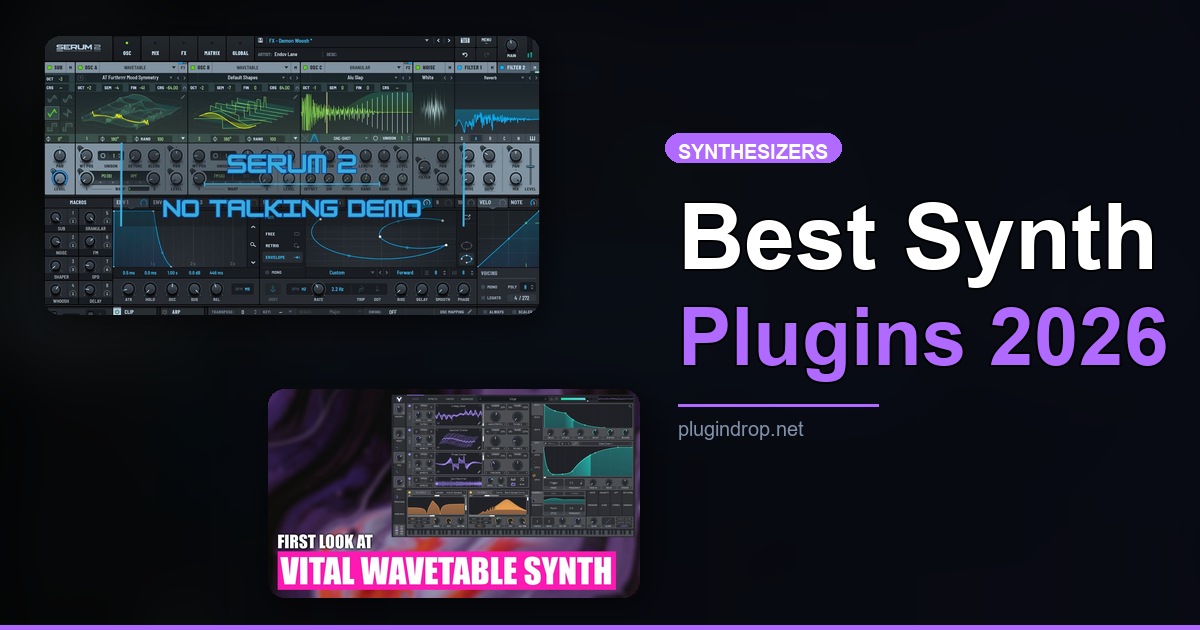
Best Synth Plugins 2026 — Ranked: Free & Paid VSTs for Every Style
TL;DR: Vital is the single best free synth plugin in 2026 — it matches paid wavetable synths at zero cost. For producers who need more, Serum remains the industry gold standard for sound design, and Phase Plant’s modular architecture rewards anyone ready to go deeper into sonic territory presets can’t reach.
Quick Picks at a Glance
| Plugin | Price | Best For | Get It |
|---|---|---|---|
| Vital | Free / $25+ | Wavetable synthesis, modern electronic | Free Download |
| Surge XT | Free | Complex modulation, experimental | Free Download |
| OB-Xd | Free | Vintage analog emulation, pads | Free Download |
| Dexed | Free | FM synthesis, DX7 patches | Free Download |
| Serum | ~$189 | Professional sound design, EDM | Get Serum |
| Phase Plant | ~$99 | Modular workflow, versatility | Get Phase Plant |
| Arturia Pigments | ~$99–$149 | Cinematic, hybrid synthesis | Get Pigments |
Introduction
Here’s the misconception that wastes producers thousands of dollars: the best synth plugins 2026 has to offer include a free wavetable synthesizer that competes directly with tools costing $189. Vital — released in 2020 — has matured to the point where production communities have shifted their debate from “should I buy Serum?” to “what does Serum actually do that Vital doesn’t?” The honest answer is nuanced, and this guide covers it directly.
The synth plugin market in 2026 looks nothing like it did five years ago. Open-source tools are genuinely professional-grade, free tiers have expanded significantly, and the gap between free and paid has narrowed in every synthesis category. Whether you produce lo-fi hip hop, dark techno, ambient, film scores, or synthwave, there’s a high-quality option at every price point — including zero.
This guide covers seven synthesizers selected for real-world usefulness, community adoption, and sound quality: four free picks that belong in every producer’s toolkit, and three paid upgrades with clearly defined reasons to invest. It’s written for producers who have moved past stock sounds and want to know exactly which tools are worth their time and money.
Best Free Synth Plugins in 2026
Vital — The Free Wavetable Synth That Changes Everything
- Developer: Matt Tytel
- Price: Free (Basic) / $25 (Plus) / $80 (Pro)
- Platforms: Windows, macOS, Linux
- Formats: VST3, AU, AAX, LV2, Standalone
Vital is a spectral warping wavetable synthesizer with three oscillators, per-oscillator wavetable morphing, a flexible filter section, and a mod matrix that makes complex routing genuinely intuitive. The critical detail: the paid tiers add preset packs, not additional synthesis features. The full engine is free. That means spectral warping, audio-to-wavetable import, and a modulation depth that rivals commercial tools are all available at no cost.
For producers in electronic genres — future bass, techno, synthpop, lo-fi — Vital is the most logical first synth install in 2026. The wavetable editor allows you to draw custom waveforms, import any audio file as a wavetable, or manipulate frequency content frame by frame. These were paid-only workflows until recently.
Best for: Electronic producers, sound designers, anyone transitioning from stock DAW instruments.
Surge XT — Open Source, Industrial-Grade Modulation
- Developer: Surge Synth Team
- Price: Free
- Platforms: Windows, macOS, Linux
- Formats: VST3, AU, LV2, CLAP, Standalone
Surge XT is an open-source synthesizer with a scope that rivals commercial tools costing hundreds of dollars. It supports sixteen distinct oscillator types — from classic wavetable and FM to string, twist, and alias modes — and its modulation system allows virtually any parameter to modulate any other parameter with full LFO, envelope, and MIDI control. The patch library ships with thousands of presets, and the community actively contributes new content.
Where Surge XT stands apart from Vital is in modulation depth and oscillator variety. It rewards producers who enjoy deep exploration over quick preset browsing. The interface has a learning curve, but documentation is thorough and the open-source community is highly active.
Best for: Experimental producers, sound designers who want maximum modulation flexibility without a budget.
OB-Xd — Vintage Oberheim Emulation Done Right
- Developer: discoDSP
- Price: Free
- Platforms: Windows, macOS, Linux
- Formats: VST3, AU, AAX, Standalone
OB-Xd models the Oberheim OB-X, OB-Xa, and OB-8 — a family of analog polysynths that defined the sound of 1980s pop, synthwave, and cinematic scoring. The emulation captures the warmth, slight pitch instability between voices, and filter character that made those hardware units iconic. A voice detune parameter recreates the natural spread of a real poly analog without needing multiple instances or complex unison stacking.
For producers working in retrowave, synthwave, or any style that calls for lush, characterful pads and leads, OB-Xd delivers a tonal quality that most free subtractive synths don’t reach. The included preset library covers the essential Oberheim tones and makes it immediately usable out of the box.
Best for: Synthwave, retrowave, cinematic pads, vintage analog-style leads and chords.
Dexed — The Definitive Free FM Synthesizer
- Developer: Digital Suburban
- Price: Free
- Platforms: Windows, macOS, Linux
- Formats: VST3, AU, AAX, LV2, Standalone
Dexed is a faithful emulation of the Yamaha DX7, the FM synthesizer responsible for electric piano tones, metallic basses, and bell sounds that defined the sound of the 1980s and 1990s. It is fully compatible with original DX7 SysEx patch files, meaning producers have access to thousands of real hardware presets spanning four decades of DX7 programming. The six-operator FM engine is complete and includes per-voice detuning.
FM synthesis has a well-earned reputation for complexity, and Dexed doesn’t fully hide that — but it is the most accessible free FM synthesizer available. For producers working in lo-fi, funk, future bass, or any genre where classic FM textures appear, it is a mandatory install.
Best for: FM synthesis, DX7 patch compatibility, electric piano tones, metallic and bell sounds.
Worth Upgrading To (Paid Options)
The free synths above cover a wide range of synthesis types and production scenarios. These three paid options address specific situations where the investment is clearly justified.
Serum — The Industry Standard for a Reason
- Developer: Xfer Records
- Price: ~$189 (one-time) or available via Splice subscription
- Why upgrade: Vital’s wavetable engine is strong, but Serum’s oscillator quality, dedicated noise and sub oscillators, and the size of its third-party preset ecosystem make it the most efficient workflow for producers in EDM, dubstep, future bass, and pop. The volume of community presets, online courses, and shared patches has no equivalent — buying Serum in 2026 is as much an investment in an ecosystem as it is in the synthesizer itself.
Phase Plant — Modular Synthesis Without the Cable Mess
- Developer: Kilohearts
- Price: ~$99 (standalone) or included in Kilohearts subscription tiers
- Why upgrade: Phase Plant combines additive, wavetable, and sampler oscillators inside a modular signal path you construct yourself. Where Vital and Surge XT have fixed architectures, Phase Plant lets you chain generators and effects as building blocks — a workflow that’s closer to Eurorack synthesis than traditional VST design. If you’ve hit the ceiling of fixed-architecture synths or need sounds that genuinely don’t exist in any preset library, Phase Plant is the most flexible option at this price point.
Arturia Pigments — Hybrid Synthesis for Cinematic and Electronic Work
- Developer: Arturia
- Price: ~$99–$149
- Why upgrade: Pigments combines wavetable, virtual analog, sample, harmonic (additive), and granular synthesis engines — and lets you layer any two simultaneously in a single patch. That hybrid architecture opens sound design combinations no single-engine synth can reach. For composers working in cinematic, ambient, or hybrid electronic music, Pigments’ built-in FX chain and advanced arpeggiator add significant production value that free alternatives can’t replicate.
→ Get Arturia Pigments on Plugin Boutique
Full Comparison Table
| Plugin | Price | Type | Highlights | CTA |
|---|---|---|---|---|
| Vital | Free / $25–$80 | Wavetable | Spectral warping, audio-to-wavetable, deep mod matrix | Download Free |
| Surge XT | Free | Multi-engine | 16 oscillator types, extreme modulation depth, open source | Download Free |
| OB-Xd | Free | Virtual Analog | Oberheim OB-X/Xa/8 emulation, voice detune, warm character | Download Free |
| Dexed | Free | FM | DX7 emulation, SysEx compatible, 6-operator FM engine | Download Free |
| Serum | ~$189 | Wavetable | Industry-standard, massive preset ecosystem, oscillator quality | Get Serum |
| Phase Plant | ~$99 | Modular | Build-your-own signal path, additive + wavetable + sampler | Get Phase Plant |
| Arturia Pigments | ~$99–$149 | Hybrid Multi-engine | 5 engine types, layer two simultaneously, built-in FX | Get Pigments |
How to Choose
- If you’re new to synthesis or on a zero budget, install Vital first. It removes the cost barrier entirely for wavetable synthesis and covers the majority of electronic production use cases.
- If you produce EDM, dubstep, future bass, or pop professionally, Serum’s ecosystem — third-party presets, tutorials, community sharing — makes it the most time-efficient investment over any free alternative.
- If your music calls for warm vintage pads, lush chords, or classic synthwave tones, OB-Xd is the precise tool for that job. No free subtractive synth matches its Oberheim character.
- If FM tones, electric pianos, or metallic textures appear in your productions, Dexed is the correct free install — full DX7 compatibility means thousands of real hardware patches are immediately available.
- If you produce cinematic, ambient, or experimental music and need synthesis combinations beyond wavetable or subtractive, Arturia Pigments’ five-engine hybrid architecture is purpose-built for that territory.
- If you’ve outgrown fixed-architecture synths and want to design sounds from first principles, Phase Plant’s modular approach offers the most flexibility at its price point anywhere in the market.
FAQ
What is the best free synth plugin in 2026? Vital is the consensus answer among producers and sound designers. The free tier includes the complete synthesis engine — wavetable morphing, spectral warping, mod matrix — with only preset packs locked behind paid tiers. It’s the most capable free synthesizer currently available.
Is Serum still worth buying in 2026? Yes, specifically for producers in EDM and adjacent genres. What Serum offers in 2026 isn’t just the synth itself — it’s the ecosystem. The volume of available third-party presets, tutorial content, and community adoption makes it the most workflow-efficient choice for those styles, even with strong free alternatives available.
What synth plugin is best for FM synthesis? Dexed is the definitive free option, with full DX7 SysEx patch compatibility and access to decades of real hardware programming. For producers who want more FM operators or a more modern interface, paid alternatives are worth considering, but Dexed handles the DX7 territory completely.
Can I use these plugins with any DAW? All seven plugins listed here support VST3, which is compatible with Ableton Live, FL Studio, Cubase, Studio One, Reaper, Bitwig, and virtually every other major DAW. macOS users also get AU support on most of these. Vital and Dexed include AAX for Pro Tools compatibility.
Is Phase Plant hard to learn? It has a steeper curve than fixed-architecture synths because you build the signal path yourself. Producers with experience in modular synthesis or Max/MSP will adapt quickly. Those new to synthesis should start with Vital or Surge XT and move to Phase Plant once they understand signal flow fundamentals.
Final Thoughts
If you install only one synth from this guide, make it Vital — it delivers high-quality wavetable synthesis at no cost and will cover the majority of electronic music production needs without requiring any investment. When the time comes to upgrade, Serum’s ecosystem makes it the most practical paid choice for genre-focused producers, while Phase Plant is the right call for anyone who wants to design sounds that simply don’t exist in any preset library.
→ Get Serum — the industry standard wavetable synthesizer
Related Guides
- Serum VST Review 2026: Is It Still the Best Wavetable Synth?
- Arturia V Collection 10 Review: 40+ Vintage Synths Worth the Price?
- 12 Best Vintage Synth VST Emulations in 2026 (Moog, Roland, Oberheim)
- Vital Synthesizer Review 2026: The Best Free Alternative?
- Is Serum Worth It in 2026?
This post contains affiliate links. We may earn a small commission at no extra cost to you.
Comparing bundles? See our Plugin Bundle Price Comparison for cost-per-plugin rankings across FabFilter, NI Komplete, iZotope, and more.
This post contains affiliate links. We may earn a small commission at no extra cost to you.