FabFilter Pro-L 2 Review: Still the Best Mastering Limiter in 2026?
TL;DR: FabFilter Pro-L 2 is still the mastering limiter most professionals reach for first in 2026 — eight precisely tuned limiting algorithms, true peak control up to 32x oversampling, and a metering suite that handles every modern streaming target without a separate tool. At $199 it is a premium investment, but nothing else at this price offers the same combination of transparency, loudness control, and workflow depth.
Quick Picks at a Glance
| Plugin | Price | Best For | Get It |
|---|---|---|---|
| FabFilter Pro-L 2 | $199 | Professional mastering, every genre | Official Site |
| iZotope Ozone 12 | $499+ | Full AI-assisted mastering suite | Official Site |
| FabFilter Total Bundle | $899 | Every FabFilter tool, best per-plugin value | Plugin Boutique |
Introduction
Here is the conversation that keeps repeating in mastering forums: someone posts their signal chain for critique, gets feedback on their limiter, asks what to replace it with, and thirty comments in the answer is almost always the same — FabFilter Pro-L 2. That consensus has held for nearly a decade. In a plugin market where new tools launch every month and community opinions shift fast, that kind of stability is worth scrutinising rather than accepting at face value. This FabFilter Pro-L 2 limiter review mastering 2026 guide does exactly that.
Streaming normalization fundamentally changed what a mastering limiter needs to do. Spotify’s -14 LUFS target, Apple Music’s -16 LUFS, YouTube’s -14 LUFS — hitting these platform targets while preventing inter-sample peaks from distorting on decode is now the core technical challenge of mastering for distribution. Limiters that were excellent before streaming normalisation became widespread can fall short here, and the difference shows up as distortion in listeners’ ears even when the waveform looks clean on screen.
This review covers every aspect of Pro-L 2 in practical depth: all eight limiting algorithms, the metering suite, mid/side operation, CPU behaviour, and an honest comparison to its closest competitors. It is written for working engineers and serious home studio producers who want to understand whether Pro-L 2 justifies its price in 2026 — and under exactly what circumstances something else might serve them better.
What FabFilter Pro-L 2 Does
The Core Interface — Deceptively Simple, Massively Deep
- Developer: FabFilter
- Price: $199
- Platforms: Windows, macOS
- Formats: VST3, AU, AAX, VST
The Pro-L 2 interface is built around three primary controls — Input Gain, Output Ceiling, and Lookahead — arrayed beneath a large real-time gain reduction display. That simplicity is intentional: the primary limiting workflow is fast and unobstructed. The deeper controls live in the algorithm selector, the attack/release panel, and the metering suite below the main display.
The gain reduction visualisation is one of the best in the industry. It shows waveform, true peak activity, and gain reduction in a single view with a resolution that makes it immediately clear when and how hard the limiter is catching transients. On long sessions this visual feedback significantly reduces ear fatigue compared to limiters that only show numeric meters.
Best for: Engineers who want full manual control over every limiting decision, with the option to go deep on algorithm and metering detail.
Eight Limiting Algorithms — The Real Differentiator
This is where Pro-L 2 earns its price point, and where every alternative falls short of matching it. Eight distinct algorithms is not marketing padding — each one sounds and behaves meaningfully differently, and choosing the right one for a given track is a genuine skill with audible consequences.
Transparent is the most neutral algorithm, designed to maximise loudness with minimum audible artifacts. It excels on well-arranged, dynamically controlled material and is the right choice for acoustic, jazz, and classical work where fidelity is the priority. Allround is the daily workhorse — it handles the widest variety of material gracefully and is where most engineers start before fine-tuning. Dynamic introduces more movement into the gain reduction envelope, making heavily limited material feel more alive and breathable on extended listening.
Aggressive prioritises loudness over transparency, making it the correct choice for club, EDM, and hip-hop tracks where competitive volume is non-negotiable. Bus is optimised for limiting individual stems and sub-mixes rather than the full master bus — it has a different release characteristic that prevents pumping on non-full-range material. Safe gently pulls back transient peaks before the main limiting stage, which reduces inter-sample peaks at the source rather than relying entirely on the ceiling. Precision delivers a highly controlled, consistent limiting behaviour suited to broadcast, podcast, and audiobook delivery where predictability matters more than character. Stable maintains a steadier gain reduction envelope, which is particularly effective on electronic music and synth-heavy material with consistent energy.
Switching between algorithms in real time is fast via the selector, and the gain reduction display updates immediately so the difference is visible as well as audible. Experienced mastering engineers will develop strong algorithm preferences per genre; newer engineers have a meaningful learning environment built in.
True Peak Limiting and the Metering Suite
True peak limiting is not optional in 2026. Regular sample-peak limiting misses inter-sample peaks — distortion events that occur during digital-to-analogue conversion — meaning a master can measure -0.1 dBFS on a meter and still clip on playback. Pro-L 2’s true peak mode operates at up to 32x oversampling, catching the peaks that pass through cheaper or older limiters.
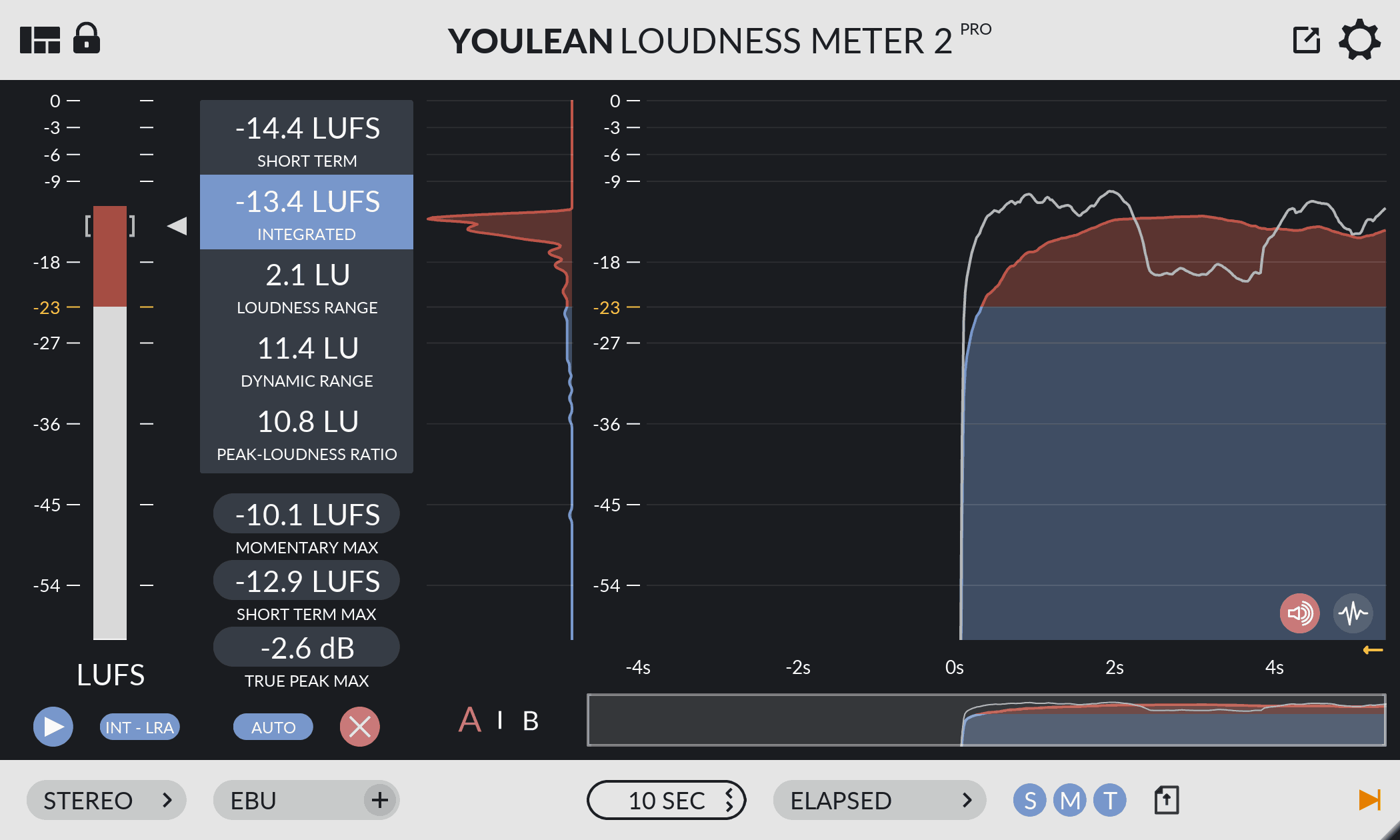
The integrated metering panel displays Short-term LUFS, Momentary LUFS, Integrated LUFS, True Peak, and Loudness Range (LRA) simultaneously and continuously. This coverage means that for the EBU R128 broadcast standard, Spotify, Apple Music, or YouTube delivery, you can verify compliance without opening a separate metering plugin. The ISP indicator is colour-coded and prominent — a detail that seems minor but saves meaningful time when troubleshooting codec distortion after export.
Mid/Side and Stereo Processing Modes
Pro-L 2 operates in three modes: Stereo Linked, Stereo Unlinked, and Mid/Side. The Mid/Side mode is where the plugin enters genuinely professional mastering territory. Processing the mid and sides independently allows for tighter control over wide, energetic mixes — you can apply heavier limiting to the sides to prevent mono compatibility issues while preserving more transient energy in the centre image.
Stereo Unlinked mode is useful on bus material where left and right channels have very different dynamics — drum overhead buses being a common example. The flexibility to switch modes per-instance without a separate M/S encoder is a meaningful workflow advantage in a professional session.
CPU Performance and DAW Integration
Pro-L 2 is efficient for its oversampling capability. At 32x true peak limiting on a modern CPU, it runs without the session instability that plagued early high-oversampling limiters. FabFilter’s interfaces are GPU-accelerated and resizable — Pro-L 2 scales cleanly from a compact insert view to a large detailed display without any UI degradation.
The A/B comparison system is standard across all FabFilter plugins and works exactly as expected: two independently adjustable states with instant switching. The preset library includes loudness targets for major streaming platforms. These presets are useful as reference points and learning tools, not as a substitute for understanding the controls.
Where Pro-L 2 Falls Short
No tool is universally optimal. Pro-L 2 operates as a broadband limiter — it does not have multiband or transient-aware limiting modes. For extremely dense, loud material in certain genres, tools like Eventide’s Elevate Bundle or a multiband approach may achieve higher loudness at equivalent perceived quality because they can address frequency-specific transient energy that a broadband limiter must handle globally.
The price is also a real consideration. At $199, Pro-L 2 is a professional tool at a professional price. For a producer who masters their own music casually and has no client work, the cost-to-use ratio is harder to justify than it is for a working engineer.
Worth Upgrading To
iZotope Ozone 12 — Full AI-assisted mastering in one suite
- Developer: iZotope
- Price: $499 (Standard), $999 (Advanced)
- Platforms: Windows, macOS
- Formats: VST3, AU, AAX
- Why upgrade: If you want a complete mastering chain — EQ, imaging, dynamics, limiting, and AI-assisted loudness matching — in a single integrated plugin, Ozone 12 provides context that Pro-L 2, as a dedicated limiter, cannot. The Master Assistant workflow significantly speeds up sessions for engineers working at high volume. The included Maximizer module is competitive, though it does not match Pro-L 2’s algorithm depth as a standalone limiter.
FabFilter Total Bundle — Every FabFilter tool, one licence
- Developer: FabFilter
- Price: $899
- Platforms: Windows, macOS
- Formats: VST3, AU, AAX, VST
- Why upgrade: Pro-L 2 pairs naturally with Pro-Q 4 (surgical EQ), Pro-C 2 (compression), Pro-MB (multiband dynamics), and Pro-DS (de-essing) in a mastering chain. Buying the Total Bundle is cheaper than purchasing Pro-L 2, Pro-Q 4, and Pro-C 2 individually, and it includes every FabFilter creative and utility plugin. For engineers already reaching for FabFilter tools at every stage of a session, the bundle is the economically rational choice.
→ Get FabFilter Total Bundle on Plugin Boutique
Full Comparison Table
| Plugin | Price | Type | Highlights | CTA |
|---|---|---|---|---|
| FabFilter Pro-L 2 | $199 | True Peak Limiter | 8 algorithms, 32x oversampling, full LUFS metering, M/S mode | Get It |
| iZotope Ozone 12 | $499+ | Full Mastering Suite | AI Master Assistant, Maximizer, complete chain in one plugin | Get It |
| FabFilter Total Bundle | $899 | Plugin Bundle | All FabFilter tools, best per-plugin value for full-chain users | Get It |
How to Choose
- If you need only a limiter, get Pro-L 2. Its algorithm depth, true peak precision, and metering suite are unmatched at $199 by any single-purpose tool.
- If you are building a mastering chain from scratch and want AI assistance and an integrated workflow, Ozone 12 is the faster entry point — though its Maximizer alone is not as versatile as Pro-L 2.
- If you already own Pro-L 2 and find yourself buying Pro-Q 4 or Pro-C 2 separately, calculate the Total Bundle cost — it is almost always cheaper than purchasing three FabFilter tools individually.
- If you master for broadcast (podcast, TV, radio), Pro-L 2’s Precision algorithm and built-in EBU R128 / ATSC A/85 metering make it the most complete single-plugin solution for delivery compliance.
- If budget is the constraint right now, use your DAW’s stock limiter and save toward Pro-L 2. The upgrade is immediately and significantly audible. Free alternatives are a sensible bridge, not a permanent substitute.
FAQ
Is FabFilter Pro-L 2 still worth buying in 2026? Yes, for anyone mastering music at a professional or serious hobbyist level. New competitors have launched, but none match Pro-L 2’s combination of algorithm variety, true peak accuracy, and integrated metering depth at this price point. The investment pays back across thousands of sessions.
Which Pro-L 2 algorithm is best for streaming delivery? Start with Allround for most material — it handles the widest range of content gracefully. Switch to Transparent for acoustic and classical work where fidelity is paramount. Use Aggressive only for competitive loudness targets in EDM, hip-hop, or club music where the genre convention accepts more density.
How do I prevent inter-sample peaks with Pro-L 2? Set your output ceiling to -1.0 dBFS (or -0.5 dBFS for extra safety), enable True Peak limiting in the settings, and monitor the ISP indicator in the metering panel throughout the session. At these settings Pro-L 2 will catch inter-sample peaks before they cause distortion on streaming platform decoding.
Can Pro-L 2 be used on individual tracks, not just the master bus? Yes. The Bus algorithm is specifically designed for stem and track limiting and has a different release characteristic that avoids the pumping that can occur when using a master bus algorithm on narrower-range material. CPU use increases at high oversampling settings, so many engineers use lower oversampling on non-master instances.
How does FabFilter Pro-L 2 compare to the Waves L2? Pro-L 2 is the more modern and more flexible tool by a significant margin. The Waves L2 remains popular for its simplicity and characteristic sound on certain material, but it has no true peak limiting, no LUFS metering, and no algorithm options. For any new purchase in 2026, Pro-L 2 is the stronger choice in almost every context.
Related Guides
- The Complete Mastering Plugin Chain: 6 Plugins for a Pro Master (2026)
- 12 Best Free Compressor VST Plugins in 2026 (Every Style Covered)
- 10 Best Free EQ VST Plugins in 2026 (Mixing & Mastering)
- 12 Best Free VST Plugins for Ableton Live in 2026
- 15 Best Free VST Plugins for FL Studio in 2026
Final Thoughts
FabFilter Pro-L 2 is not the best mastering limiter because nothing better exists — it is the best mastering limiter because no single tool at its price point matches the combination of eight production-tuned algorithms, true peak limiting at 32x oversampling, and a metering suite that makes streaming compliance straightforward. Eight years of community consensus is not inertia; it is a track record. If you are serious about mastering, this is the tool to own in 2026.
This post contains affiliate links. We may earn a small commission at no extra cost to you.
This post contains affiliate links. We may earn a small commission at no extra cost to you.