Phase Plant vs Serum 2026: Which Wavetable Synth Wins for Sound Design?
TL;DR: Serum wins for producers who want industry-standard wavetable synthesis with an approachable workflow and a massive preset ecosystem. Phase Plant wins for sound designers who need modular flexibility and the ability to stack multiple synthesis types in one patch. If you’re building a studio toolkit in 2026, Serum is the safer first buy — Phase Plant is the more powerful long-term investment.
Quick Picks at a Glance
| Plugin | Price | Best For | Get It |
|---|---|---|---|
| Phase Plant | $99 | Modular sound design, multi-synthesis textures | Get Phase Plant |
| Serum | $189 | EDM, bass music, wavetable production | Get Serum |
Introduction
Here’s what most comparison articles won’t tell you: Serum costs nearly twice as much as Phase Plant, yet Phase Plant is the more capable synthesizer by most objective measures. That gap between price and capability is exactly what makes the Phase Plant vs Serum synthesizer 2026 debate so important to get right before you spend money on either one.
Both synthesizers dominate modern production workflows, but they serve different masters. Serum built its reputation on sonic quality, accessibility, and a third-party preset market so large it essentially defines the sound of contemporary electronic music. Phase Plant took a different path — a modular architecture that lets you build synthesis chains from scratch, combining wavetable, sample-based, and analog-style generators in a single patch.
This guide cuts through the community tribalism and compares both synthesizers across six critical categories: wavetable engine, modulation, effects, presets, workflow, and value. A winner is declared for each. Whether you produce EDM, design sounds for games, or are just getting started with synthesis, this breakdown will tell you exactly which one deserves your money.
Wavetable Engine & Sound Generation
The core of any wavetable synthesizer is how it generates and shapes sound. This is where the two tools diverge most dramatically.
Phase Plant — Modular power with multiple synthesis modes
- Developer: Kilohearts
- Price: $99
- Platforms: Windows, macOS
- Formats: VST3, AU, AAX, Standalone
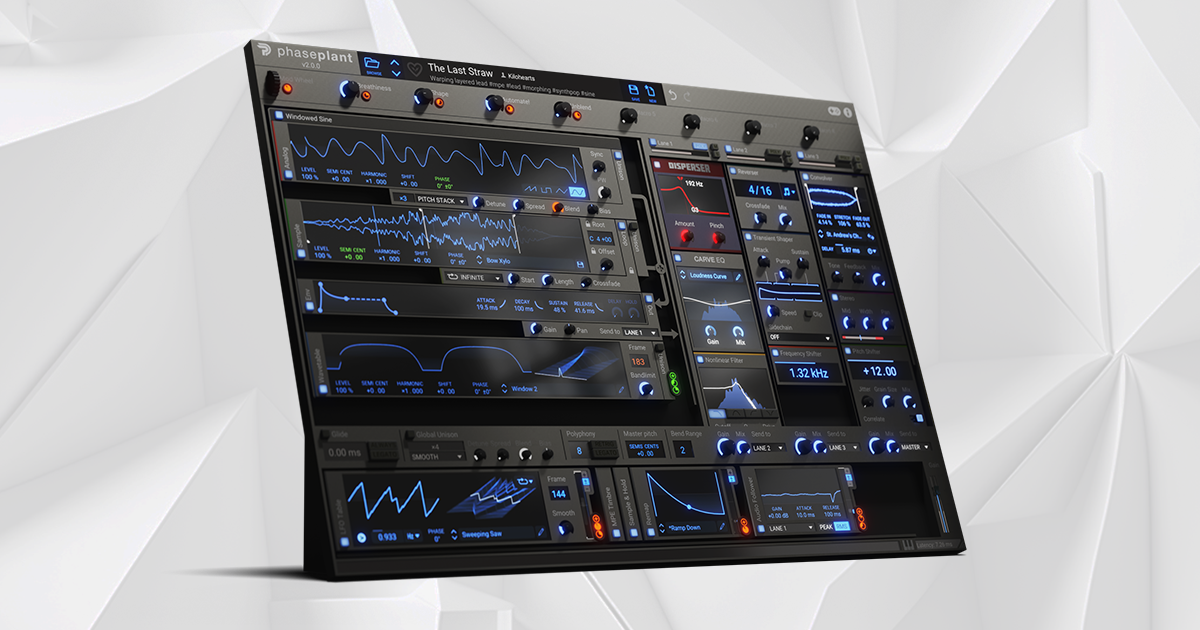
Phase Plant’s generator system lets you stack multiple sound sources — wavetable, analog, sample, noise, and more — within a single patch. You are not locked into one synthesis paradigm. A single preset can combine a wavetable generator running through a wavefolder with a sample generator layered underneath, all feeding into a shared filter stack. That level of flexibility is extraordinary at this price point.
Best for: Sound designers who want to combine synthesis types and build complex, layered textures from the ground up.
Serum — Industry-standard wavetable with a best-in-class editor
- Developer: Xfer Records
- Price: $189
- Platforms: Windows, macOS
- Formats: VST3, AU, AAX, Standalone
Serum’s built-in wavetable editor is one of the best available in any synthesizer. You can import audio, draw custom waveforms, apply spectral analysis, and generate wavetables from scratch — all within a clean, purpose-built interface. The oscillator quality is pristine, and Serum’s “noise” oscillator doubles as a flexible sample playback source. It is a focused instrument that does wavetable synthesis exceptionally well.
Best for: Producers who want high-quality wavetable synthesis with professional-grade editing tools and a clearly defined workflow.
Category Winner: Phase Plant — More synthesis modes and stacking flexibility give it the edge. Serum’s wavetable editor is excellent, but it remains a single synthesis paradigm.
Modulation System
Modulation is what transforms a static patch into something alive and expressive. Both synthesizers take meaningfully different approaches.
Phase Plant — Deep modulation with visual routing clarity
- Developer: Kilohearts
- Price: $99
- Platforms: Windows, macOS
- Formats: VST3, AU, AAX, Standalone
Phase Plant’s modulation system uses a drag-and-drop lane layout where you see every active connection at a glance. LFOs, envelopes, macro controls, and MIDI sources all share the same modulation pool. You can modulate virtually any parameter — including parameters inside the Snapin effects chain — and stack multiple modulators on a single target. Auditing a complex patch never requires guesswork.
Best for: Sound designers who need deep, traceable modulation chains without losing track of signal flow.
Serum — Intuitive matrix with an excellent LFO editor
- Developer: Xfer Records
- Price: $189
- Platforms: Windows, macOS
- Formats: VST3, AU, AAX, Standalone
Serum’s drag-and-drop modulation matrix shows depth indicators directly on each knob, so the impact of any modulation source is immediately visible. Its LFO editor supports freely drawn custom shapes, step-sequencer mode, and envelope mode — all in one panel. For the vast majority of production use cases, Serum’s modulation system is more than sufficient, and its accessibility means producers actually use it rather than leaving patches flat.
Best for: Producers who want powerful modulation that is genuinely enjoyable to use without consulting documentation.
Category Winner: Phase Plant — Greater modulation depth and clearer routing visibility. Serum’s LFO editor is arguably more fun for everyday use, but Phase Plant goes further.
Built-in Effects
Phase Plant — Snapin ecosystem integration
- Developer: Kilohearts
- Price: $99
- Platforms: Windows, macOS
- Formats: VST3, AU, AAX, Standalone
Phase Plant uses the Kilohearts Snapin ecosystem for its effects chain. If you own additional Kilohearts Snapins (sold separately), they slot directly into Phase Plant’s effects lanes — a genuinely powerful workflow for Kilohearts users. The bundled effects cover the essentials, but the selection feels thin compared to Serum if you do not own additional Snapins. This is the one area where Phase Plant’s modular philosophy works against newcomers.
Best for: Producers already invested in the Kilohearts ecosystem, or those planning to expand their Snapin library over time.
Serum — Complete, self-contained effects chain
- Developer: Xfer Records
- Price: $189
- Platforms: Windows, macOS
- Formats: VST3, AU, AAX, Standalone
Serum ships with a full professional effects section: distortion, hyper/dimension, chorus, phaser, flanger, EQ, filter, reverb, compressor, delay, and more. Every effect sounds polished and integrates tightly with the preset system — a Serum preset carries its full effects chain, so commercial packs arrive production-ready. This alone justifies much of Serum’s price premium for producers who want a complete, self-contained instrument.
Best for: Producers who want a finished synthesizer that sounds professional without routing through external plugins.
Category Winner: Serum — A complete, integrated effects chain that ships ready to use. Phase Plant’s modular approach is powerful but requires additional investment to match it.
Preset Library & Community Resources
Phase Plant — Growing library, educational presets
- Developer: Kilohearts
- Price: $99
- Platforms: Windows, macOS
- Formats: VST3, AU, AAX, Standalone
Phase Plant’s preset market is growing but still trails Serum considerably. Kilohearts ships a solid factory bank, and third-party developers are increasingly producing Phase Plant content. The modular architecture means presets tend to be instructive — opening one teaches you something about synthesis technique. That quality is a feature for sound designers and a limitation for producers who want to drop a patch in and move on.
Best for: Producers who want to learn synthesis through presets rather than simply use them as-is.
Serum — The dominant preset ecosystem
- Developer: Xfer Records
- Price: $189
- Platforms: Windows, macOS
- Formats: VST3, AU, AAX, Standalone
Serum has the largest third-party preset market of any synthesizer currently available. Tens of thousands of commercial packs span every genre — future bass, dubstep, cinematic, techno, lo-fi, and beyond. Every major sound designer releases Serum content. The YouTube tutorial ecosystem is equally vast, meaning any technique or genre you want to learn has dedicated Serum material already waiting for you.
Best for: Producers who want immediate access to professional sounds and an enormous knowledge base to draw from.
Category Winner: Serum — It is not close. Serum’s preset and tutorial ecosystem is the largest in the synthesizer world right now.
Learning Curve & Workflow
Phase Plant — Steep but deeply rewarding
- Developer: Kilohearts
- Price: $99
- Platforms: Windows, macOS
- Formats: VST3, AU, AAX, Standalone
Phase Plant rewards patience. The modular architecture means there is no single prescribed signal path — you design it yourself. That freedom is exhilarating for experienced synthesists and genuinely overwhelming for beginners. Once you understand the generator/shaper/modulation paradigm, the interface is logical and efficient. Expect a few dedicated hours of learning before you’re building patches with real confidence.
Best for: Sound designers and producers with some synthesis background who value depth over instant gratification.
Serum — Accessible without being shallow
- Developer: Xfer Records
- Price: $189
- Platforms: Windows, macOS
- Formats: VST3, AU, AAX, Standalone
Serum’s interface is a masterclass in synthesizer UI design. Every element lives on a single screen across clearly labeled panels. Oscillators, filters, effects, modulation, and the wavetable editor never obscure each other. A producer with basic synthesis knowledge can build usable sounds within an hour. The depth is there — Serum supports complex modulation and advanced wavetable manipulation — but it never forces that complexity on you before you are ready for it.
Best for: Producers at any skill level who want results quickly while retaining meaningful room to grow.
Category Winner: Serum — More accessible entry point without sacrificing meaningful depth.
Value for Money
Phase Plant — More synthesis capability per dollar
- Developer: Kilohearts
- Price: $99
- Platforms: Windows, macOS
- Formats: VST3, AU, AAX, Standalone
At $99, Phase Plant delivers a synthesis engine that rivals tools costing three times as much. The modular architecture, multiple generator types, and integration with the Kilohearts Snapin ecosystem represent genuine long-term value. Budget for additional Snapin purchases if you plan to build out the effects chain — but even standalone, the core instrument is exceptional for the price.
Best for: Budget-conscious producers who prioritize synthesis power over immediate out-of-the-box usability.
Serum — Premium price with clear justification
- Developer: Xfer Records
- Price: $189
- Platforms: Windows, macOS
- Formats: VST3, AU, AAX, Standalone
Serum at $189 is a meaningful investment for a single synthesizer, but the all-in pricing means no hidden costs. The complete effects chain, wavetable editor, and lifetime updates are included. Given the size of the free community preset library, the effective cost-per-sound over a year of active use drops considerably. Serum also holds its value in professional contexts — it appears on nearly every working producer’s plugin list.
Best for: Producers who want a single, complete tool that justifies its price from the first session.
Category Winner: Phase Plant — Better dollars-to-capability ratio. Serum’s all-in pricing has real workflow value, but Phase Plant simply delivers more synthesis for less money.
Worth Upgrading To (Paid Options)
Phase Plant — The Kilohearts Ecosystem
- Developer: Kilohearts
- Price: $99 (Phase Plant standalone); Toolbox bundles available separately
- Why upgrade: Phase Plant’s standalone built-in effects are limited. Expanding with Kilohearts Snapins — individually or via a bundle — significantly increases its sound design range and transforms it into a fully self-contained production tool.
Serum — The Complete Purchase
- Developer: Xfer Records
- Price: $189
- Why upgrade: Serum is a single, complete purchase with no meaningful expansion required. The full effects chain, wavetable editor, and ongoing preset compatibility are all included at the standard price — the upgrade path here is simply buying it.
Full Comparison Table
| Plugin | Price | Type | Highlights | CTA |
|---|---|---|---|---|
| Phase Plant | $99 | Modular multi-synthesis | Generator stacking, Snapin integration, deep modulation routing | Get It |
| Serum | $189 | Wavetable | Built-in wavetable editor, complete FX chain, massive preset ecosystem | Get It |
How to Choose
- If you produce EDM, future bass, dubstep, or pop, choose Serum — the preset ecosystem and tutorial library are built around these genres, and you will be productive from day one.
- If you design sounds for games, film, or experimental music, choose Phase Plant — the modular multi-synthesis architecture creates textures that a standard wavetable synth simply cannot replicate.
- If you are new to synthesis, choose Serum — the single-screen interface rewards curiosity without punishing inexperience, and the YouTube tutorial library is enormous.
- If you want maximum synthesis capability on a budget, Phase Plant at $99 delivers more raw power per dollar, provided you are willing to invest time in learning its architecture.
- If you already own Kilohearts Snapins, Phase Plant becomes an even clearer choice — the Snapin integration turns it into a significantly more capable instrument than its base price suggests.
- If you want both, buy Phase Plant first to build your synthesis fundamentals, then add Serum for its preset ecosystem. The knowledge transfers directly.
FAQ
Is Phase Plant better than Serum? Phase Plant is more capable as a synthesis engine — it supports multiple synthesis types in a single patch and has a deeper modular architecture. Serum is more polished, more accessible, and has a far larger preset and community ecosystem. Which is better depends on your workflow and goals.
Can Phase Plant do everything Serum can? Phase Plant can replicate most of Serum’s core wavetable functionality and go considerably further with its modular generator system. It cannot match Serum’s built-in wavetable editor quality or its third-party preset compatibility — Serum presets are exclusive to Serum.
Is Serum worth $189 in 2026? Yes, for most producers. Serum’s combination of audio quality, workflow efficiency, a complete effects chain, and its unmatched ecosystem support justify the price in a professional context. The free community preset library extends its value significantly over time.
Do professional producers use Phase Plant? Phase Plant has a strong following among sound designers and producers working in bass music, cinematic scoring, and experimental electronic genres. Its adoption is growing rapidly, though it has not yet matched Serum’s near-universal presence in professional studio environments.
Which synthesizer is easier to learn? Serum is significantly more accessible. Its single-screen layout, approachable modulation system, and extensive tutorial library make it the clear choice for producers new to wavetable synthesis. Phase Plant’s modular architecture requires meaningful upfront conceptual investment before it becomes intuitive.
Final Thoughts
For most producers in 2026, Serum is the safer and more immediately rewarding choice — its workflow, preset ecosystem, and complete built-in effects chain make it a self-contained instrument that earns its price from the first session. But if sound design is your priority and you want a synthesizer with genuine long-term depth, Phase Plant at $99 is an extraordinary value that repays every hour you invest in learning it.
→ Get Serum on Xfer Records | → Get Phase Plant on Kilohearts
Related Guides
- Serum VST Review 2026: Is It Still the Best Wavetable Synth?
- Vital Synthesizer Review 2026: The Best Free Alternative to Serum?
- 14 Best Free Synth VST Plugins in 2026 (Try Before You Buy)
- Is Serum Worth It in 2026?
- Best Synth VST Plugins 2026: Top 12 Picks Ranked
This post contains affiliate links. We may earn a small commission at no extra cost to you.
This post contains affiliate links. We may earn a small commission at no extra cost to you.