Valhalla Room vs VintageVerb 2026: Which Reverb Is Right for You?
TL;DR: Valhalla Room excels at clean, naturalistic spaces — ideal for acoustic instruments, orchestral beds, and anything that needs to sit invisibly in a mix. Valhalla VintageVerb wins when you want vintage hardware character, lush modulation, and that unmistakable 70s/80s bloom on synths, drums, and pads. At $50 each, both are essential — but your genre decides which you buy first.
Quick Picks at a Glance
| Plugin | Price | Best For | Get It |
|---|---|---|---|
| Valhalla Room | $50 | Natural rooms, acoustic mixing, orchestral | Plugin Boutique |
| Valhalla VintageVerb | $50 | Vintage character, synths, 80s drums, pads | Plugin Boutique |
Introduction
If you’ve spent more than five minutes browsing reverb plugins, you’ve already run into Valhalla DSP. The Vermont-based one-man operation, built by algorithm designer Sean Costello, has quietly assembled one of the most respected plugin catalogs in the industry. Searching “Valhalla Room vs VintageVerb 2026” is one of the most common plugin questions I get from readers, and it’s a question worth answering properly.
Both plugins cost $50. Both are CPU-efficient. Both share Valhalla’s signature no-nonsense interface. And both sound genuinely excellent — which is precisely what makes choosing between them non-obvious. The difference, though, is meaningful. Buying the wrong one for your workflow isn’t a disaster, but it means spending months using a tool that’s working against your material rather than with it.
This guide breaks down each plugin’s character, algorithms, ideal use cases, and head-to-head verdict across the production scenarios that actually matter. By the end, you’ll know exactly which one to buy first — and why you’ll eventually want both.
Sound Character & Philosophy
The core difference between these two plugins lives in their design philosophy. Room is about realism and transparency. VintageVerb is about color and character. Everything else flows from that.
Valhalla Room — Transparent, Natural, Mix-Ready
- Developer: Valhalla DSP
- Price: $50
- Platforms: Windows, macOS
- Formats: VST, VST3, AU, AAX
Valhalla Room is built around 12 room algorithms, ranging from intimate chambers to vast concert halls. The emphasis throughout is on natural-sounding decay — the kind that integrates into a mix without drawing attention to itself. Costello designed Room to serve the source material rather than impose a sonic signature on it. You get a sense of space, depth, and air without the reverb ever announcing itself as a plugin.
The algorithms include Neutral, Noisy, Noisy Bright, Open Air, Bright, Dark, and Smooth, each modeling subtly different acoustic behaviors. Room’s modulation section exists but stays restrained — you can dial it in or switch it off entirely. That restraint is deliberate. It’s what makes Room the default choice for engineers mixing acoustic instruments, classical recordings, or any source that needs to sound physically present in a believable space.
Best for: Acoustic instruments, orchestral mixing, singer-songwriter production, dialogue, and anything that needs invisible depth without added color.
→ Get Valhalla Room on Plugin Boutique
Valhalla VintageVerb — Colored, Characterful, Classically Inspired
- Developer: Valhalla DSP
- Price: $50
- Platforms: Windows, macOS
- Formats: VST, VST3, AU, AAX
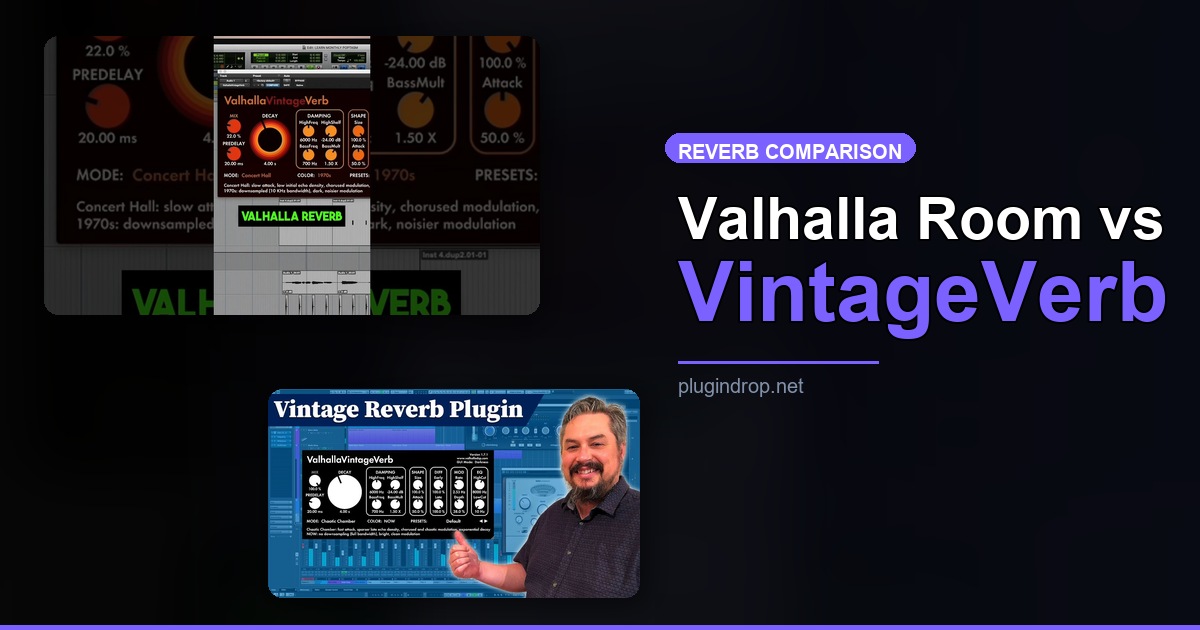
VintageVerb takes a fundamentally different approach. Its 18 algorithms are inspired by landmark hardware reverb units from the 1970s and 80s — plates, halls, chambers, and ambiences that defined the sound of classic recordings. Each algorithm can be run in three Color modes: Now (modern and neutral), 1970s (lo-fi, darker, and noisier), and 1980s (brighter, more aggressive, with that characteristic digital shimmer).
The modulation in VintageVerb is more prominent and present than Room’s by design. Even at conservative settings, you’ll notice a lush, breathing quality to the tail that adds movement to pads, synths, and drum rooms. This is the reverb that makes snare plates bloom, makes 80s guitar spring to life, and gives synthesizer chords that unmistakable depth. The Color modes alone make VintageVerb one of the most versatile character reverbs at any price point.
Best for: Electronic production, synthwave, post-punk, indie pop, drum rooms, pads, and any situation where the reverb itself is part of the sound design.
→ Get Valhalla VintageVerb on Plugin Boutique
Algorithm Depth & Controls
Valhalla Room — Precision Over Palette
Room’s control set is focused and purposeful. Pre-delay, decay time, high and low frequency damping, modulation rate and depth, and an Early/Late balance give you surgical control over the shape of the reverb tail. The 12 modes provide meaningful variety — Noisy and Noisy Bright introduce subtle diffusion artifacts for a more lived-in feel, while Smooth and Dark deliver clean, neutral tails that sit deep in a mix without clouding the midrange.
What Room lacks, by design, is excess. There are no vintage color modes, no aggressive modulation presets, no texture generators. Every parameter does exactly what the label says. For audio engineers spending long sessions making mix decisions, this restraint is a genuine asset — you spend less time managing the reverb and more time trusting it.
Valhalla VintageVerb — A Palette With Real Range
VintageVerb’s 18 algorithms span Plates, Halls, Chambers, Ambiences, Rooms, and more — a significantly broader vocabulary than Room. The three Color modes effectively triple your starting points, since the same algorithm sounds meaningfully different in 1970s mode versus Now. You’re looking at 54 distinct algorithm-and-color combinations before you touch a single knob.
The modulation section mirrors Room’s layout but reaches further. Crank the mod rate on a plate algorithm in 1980s mode and you get that shimmering, chorus-adjacent reverb tail that defined so much of the decade’s pop production. Back it off to near-zero and you get something far more controlled. The range here is genuinely impressive, and it’s what separates VintageVerb from the “clean algorithmic reverb” category that Room leads.
CPU Performance
Both plugins are exceptionally efficient. Valhalla DSP is known for aggressive algorithm optimization, and neither plugin should stress modern hardware. In real-world sessions, you can run multiple instances of both simultaneously without meaningful CPU impact.
Room trends slightly lighter in some high-instance configurations, but the difference is negligible in practice. Either plugin is safe to use as a global send reverb across an entire session — no freezing required.
Head-to-Head: Genre & Use Case Verdict
Acoustic & Orchestral Work — Room Wins
Room’s neutral algorithms and subtle modulation make it the clear choice for acoustic instruments, classical arrangements, and anything that needs to sound like a physical space. VintageVerb’s color modes can feel intrusive on acoustic sources unless dialed back to near-inaudible levels — at which point you’re working against the plugin’s strengths.
Electronic Production & Synthwave — VintageVerb Wins
This is VintageVerb’s home territory. The 1970s and 1980s color modes were designed for synth leads, drum machines, and analog pads. Room can handle electronic production, but it lacks the inherent movement and color that VintageVerb delivers as a baseline. On arpeggiated synthesizers and layered pads in particular, VintageVerb produces sounds Room simply cannot replicate.
Vocal Production — Context Dependent
For naturalistic, intimate vocals in folk or acoustic pop, Room is more forgiving and mix-friendly. For heavily produced vocals where the reverb is part of the performance character — classic plate sounds, gated backing vocals, 80s-style lead treatments — VintageVerb is the more effective creative tool.
Rock & Drum Recording — VintageVerb Wins (Slightly)
VintageVerb’s plate and room algorithms on drums carry a classic analog hardware weight that’s hard to replicate. Room produces excellent drum reverb, but VintageVerb’s 1970s plate mode in particular nails the drum sound of classic rock records in a way that few algorithmic reverbs can.
Film Scoring & Cinematic Work — Room Wins
Room’s naturalistic algorithms and wide dynamic range make it the better choice for anything picture-locked or requiring nuanced spatial imaging. VintageVerb works for stylized cinematic work, but Room handles naturalistic stage and hall spaces with greater precision and reliability across varying material.
Worth Upgrading To
Both plugins in this comparison are premium tools worth every cent of their $50 price. If you’re currently working with reverb bundled in your DAW or free third-party options, either represents an immediate and audible upgrade.
Valhalla Room — The Industry-Standard Natural Reverb
- Developer: Valhalla DSP
- Price: $50
- Why upgrade: DAW-bundled reverbs lack the algorithm depth, pre-delay precision, and frequency-shaping controls Room provides. The improvement in tail transparency on acoustic sources and mix buses is immediately apparent on first use.
→ Get Valhalla Room on Plugin Boutique
Valhalla VintageVerb — The Creative Character Reverb Worth Owning
- Developer: Valhalla DSP
- Price: $50
- Why upgrade: Free reverbs don’t model vintage hardware behavior with any accuracy. The Color modes and algorithm variety in VintageVerb deliver sounds that aren’t available at the free tier — sounds that defined entire decades of recorded music.
→ Get Valhalla VintageVerb on Plugin Boutique
Full Comparison Table
| Plugin | Price | Type | Highlights | CTA |
|---|---|---|---|---|
| Valhalla Room | $50 | Algorithmic Room Reverb | 12 algorithms, transparent tail, precise damping controls, low CPU | Buy Now |
| Valhalla VintageVerb | $50 | Vintage Algorithmic Reverb | 18 algorithms, 3 Color modes, lush modulation, 54 starting points | Buy Now |
How to Choose
- If you mix acoustic instruments, orchestral arrangements, or singer-songwriter records, go with Valhalla Room — its natural algorithms blend into the mix without adding unwanted color or movement.
- If you produce electronic music, synthwave, post-punk, or anything built around vintage drum machines and synthesizers, VintageVerb is your plugin — the Color modes give you sounds Room simply cannot produce.
- If your primary use case is vocals, start with Room for naturalistic pop and folk production; choose VintageVerb if you’re chasing classic plate sounds or heavily processed reverb as a stylistic element.
- If your budget allows only one, consider your most common session type: transparent mixing points clearly to Room; creative sound design and genre production points clearly to VintageVerb.
- If you’re a session engineer working across genres, buy both — at $50 each, together they cover virtually every reverb scenario you’ll face at a professional level without a single workflow gap.
FAQ
Is Valhalla Room or VintageVerb better for beginners? Room has a slightly more focused parameter set, which can feel less overwhelming. That said, VintageVerb’s presets are arguably more inspiring as starting points for producers still developing their ear. Both share Valhalla’s famously approachable interface, so either works well for beginners.
Do Valhalla plugins have a free trial? Yes. Valhalla DSP offers fully functional 14-day demos of both Room and VintageVerb directly from their website. This makes the purchase decision low-risk — test both for two weeks on your own material before committing to either.
Are Valhalla Room and VintageVerb compatible with Apple Silicon? Yes. Both plugins are native Apple Silicon compatible, running efficiently on M-series Macs without Rosetta emulation. They are also fully compatible with current Windows versions.
Can I run both plugins in the same session? Absolutely, and many engineers do exactly this — Room on acoustic sources and orchestral beds, VintageVerb on drums and synths. They complement each other well and don’t compete for the same sonic space when used with intention.
Are there free Valhalla plugins worth trying before buying? Yes. Valhalla DSP offers Valhalla Supermassive (massive ambient reverb and delay effects) and Valhalla Freq Echo as free downloads. Neither replaces Room or VintageVerb, but both give you a feel for Costello’s sound design philosophy and the Valhalla GUI before you spend anything.
Final Thoughts
Valhalla Room and VintageVerb are two of the best-value reverb plugins on the market regardless of price point, and at $50 each they’re near-impossible to justify skipping. Room is the clear pick for engineers who need a transparent, natural-sounding reverb that serves the mix and disappears into it. VintageVerb is the pick for producers who want classic hardware character built into their sound. If your sessions span both worlds — and most eventually do — buy both.
→ Get Valhalla Room on Plugin Boutique | → Get Valhalla VintageVerb on Plugin Boutique
This post contains affiliate links. We may earn a small commission at no extra cost to you.
Related Guides
- Valhalla VintageVerb Review: The $50 Reverb That Beats Plugins 10x Its Price
- Best Free Reverb VST Plugins 2026
- Best Reverb Plugins 2026: Full Paid Comparison
- Free Alternative to Valhalla Reverb
- Best Mixing Plugins 2026: Full Production Suite
This post contains affiliate links. We may earn a small commission at no extra cost to you.