FabFilter Pro-Q 3 vs iZotope Neutron 4: Which EQ Wins for Mixing?
TL;DR: FabFilter Pro-Q 3 is the unmatched industry-standard parametric EQ — surgical, transparent, and built for engineers who know exactly what they want. iZotope Neutron 4 wins when you need AI-guided starting points, a complete channel strip, and intelligent frequency conflict detection across a full mix. In 2026, Pro-Q 3 is the better EQ; Neutron 4 is the better mixing suite.
Quick Picks at a Glance
| Plugin | Price | Best For | Get It |
|---|---|---|---|
| FabFilter Pro-Q 3 | $179 | Precision EQ, mastering, surgical cuts | Plugin Boutique |
| iZotope Neutron 4 | $249 | AI-assisted mixing, full channel strip | Plugin Boutique |
| FabFilter Total Bundle | ~$899 | Complete FabFilter plugin suite | Plugin Boutique |
Introduction
When it comes to the FabFilter Pro-Q 3 vs iZotope Neutron 2026 debate, you’re not just comparing two EQ plugins — you’re choosing between two fundamentally different philosophies of mixing. Pro-Q 3 is a precision instrument that trusts your ears and experience. Neutron 4 is an intelligent mixing suite that meets you where you are, with AI-powered analysis and guidance built directly into its workflow.
Both plugins are genuine industry standards used on major label releases every day. Both justify their price without hesitation. But they solve different problems, appeal to different types of engineers, and deliver value in different ways. Picking the wrong one for your use case means paying for capabilities you’ll never use.
This guide breaks down every major category — sound quality, workflow, AI features, dynamic EQ, and value for money — and declares a clear winner for each. By the end, you’ll know exactly which EQ deserves a permanent slot in your signal chain.
The Contenders
FabFilter Pro-Q 3 — The surgical precision EQ that engineers trust
- Developer: FabFilter
- Price: $179
- Platforms: Windows, macOS
- Formats: VST, VST3, AU, AAX
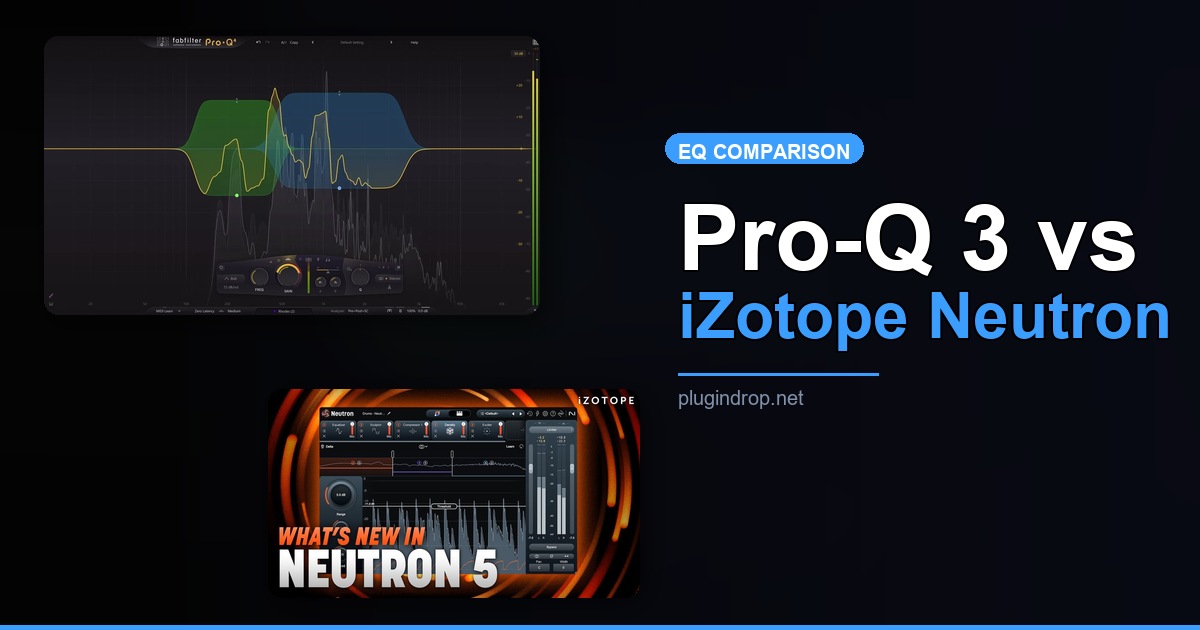
FabFilter Pro-Q 3 has been the go-to parametric EQ for professional mixing and mastering engineers for years, and its reputation is entirely earned. It offers up to 24 bands of ultra-clean EQ with a zero-latency natural phase mode, a full linear phase mode, and per-band dynamic EQ capability built in. The spectrum analyzer is real-time, highly detailed, and features a unique collision display that highlights conflicting frequency regions between instances.
Mid/Side and Left/Right processing modes are included, as is an EQ Match function for importing reference track curves. It’s available in Mono, Stereo, and Surround configurations up to 24 channels. There are very few professional mixing or mastering workflows where Pro-Q 3 doesn’t fit.
Best for: Engineers who demand transparent, artifact-free EQ with total manual control over every parameter.
→ Get FabFilter Pro-Q 3 on Plugin Boutique
iZotope Neutron 4 — The AI-powered channel strip for the modern producer
- Developer: iZotope
- Price: $249
- Platforms: Windows, macOS
- Formats: VST3, AU, AAX
iZotope Neutron 4 is not just an EQ — it’s a complete intelligent channel strip featuring EQ, compressor, transient shaper, exciter, gate/expander, and limiter, all wrapped around iZotope’s machine learning analysis engine. The Track Assistant analyzes your audio and generates a customized starting point tailored to the specific instrument or sound source, which alone can save hours of setup time on large sessions.
The standout feature unique to Neutron 4 is the Unmask tool, which detects frequency masking conflicts between separate tracks and suggests — or automatically applies — corrective moves across multiple channels simultaneously. Visual Mixer integration and inter-plugin communication make it a genuinely ecosystem-level tool, not just a plugin you drop on a single channel.
Best for: Producers and mixing engineers who want AI-guided starting points, frequency conflict detection, and a complete channel strip in a single plugin.
→ Get iZotope Neutron 4 on Plugin Boutique
Head-to-Head: Interface & Workflow
FabFilter’s interface design is legendary, and Pro-Q 3 represents the pinnacle of that philosophy. The interactive frequency display lets you drag bands directly on the spectrum, the UI scales cleanly on any screen size, and the entire workflow is frictionless. Keyboard shortcuts, scroll-wheel parameter adjustments, and band-type toggling are all fast and intuitive. For engineers with a clear vision of what they need, nothing gets in the way.
Neutron 4’s interface is more complex by necessity — it houses six processing modules, an AI assistant panel, and inter-plugin communication displays all within one window. The upside is context: Neutron actively tells you why it’s making suggestions, and the Track Assistant’s visual feedback is genuinely educational. The learning curve is steeper, but the ceiling for what you can accomplish quickly — especially without deep EQ experience — is significantly higher.
Winner: FabFilter Pro-Q 3 for pure EQ workflow speed. Neutron 4 for guided, full channel strip mixing.
Head-to-Head: Sound Quality & Transparency
Both plugins sound excellent at their highest quality settings. Pro-Q 3’s Zero Latency mode is virtually transparent for gentle boosts and cuts, and the Linear Phase mode delivers mastering-grade precision where phase coherence is critical. The filter algorithms are among the most refined available in any software EQ today.
Neutron 4’s EQ module is also clean and musical, but it’s tuned for decisions made in the context of a full mix rather than isolation. Some engineers note that Neutron’s EQ has a subtly more “musical” character during aggressive boosts, while others specifically want Pro-Q 3’s complete neutrality. For mastering and critical listening work, Pro-Q 3’s transparency is objectively the stronger choice.
Winner: FabFilter Pro-Q 3 on raw transparency. Both perform excellently in a busy mix context.
Head-to-Head: Dynamic EQ Capabilities
Dynamic EQ is where things get interesting. Pro-Q 3 introduced per-band dynamic EQ, allowing any of its 24 bands to operate as a frequency-specific compressor or expander. The implementation is elegant — you set a threshold and the band responds proportionally to signal content at that frequency. It’s particularly effective for taming resonances that only appear at higher volumes, without affecting the character of the sound at lower levels.
Neutron 4’s dynamic EQ is similarly capable, but the AI can suggest dynamic EQ settings based on real-time track analysis. If you’re working a vocal with a harsh presence peak that only spikes occasionally, Neutron’s Track Assistant can identify this and apply a dynamic cut automatically as a starting point. That workflow advantage is meaningful for engineers who process high volumes of material on tight deadlines.
Winner: Tie — Pro-Q 3 for precision manual control, Neutron 4 for AI-assisted dynamic EQ starting points.
Head-to-Head: AI & Intelligent Processing
This is Neutron 4’s home turf, and it dominates. The Track Assistant analyzes audio content in real-time and generates an initial EQ, compression, and processing template within seconds. The Unmask feature — which communicates between multiple Neutron instances across your session — detects frequency masking and suggests corrective moves. For producers mixing in dense arrangements with ten or more tracks competing for space, this is a genuinely powerful feature that has no equivalent in Pro-Q 3.
FabFilter Pro-Q 3 has a spectrum collision display and EQ Match, but nothing approaching Neutron’s machine learning-driven analysis. EQ Match is useful for referencing external tracks, but it’s a fundamentally different class of functionality. If AI assistance matters to your workflow, the gap between these two plugins is substantial.
Winner: iZotope Neutron 4 by a wide margin.
Head-to-Head: Value for Money
FabFilter Pro-Q 3 at $179 is a singular, best-in-class EQ. There’s no channel strip, no AI, no extras — just the world’s most refined parametric EQ. That singular focus is also its constraint; if you need compression or saturation, you’re writing additional checks.
iZotope Neutron 4 at $249 bundles an EQ, compressor, transient shaper, exciter, gate, and limiter with an AI analysis engine. Purchasing equivalent individual plugins from other developers would cost $600–$900 or more. For producers building a plugin collection from scratch, Neutron 4 represents extraordinary value. The trade-off is that no individual module quite reaches the ceiling of a dedicated best-in-class plugin in its specific category.
Winner: iZotope Neutron 4 for overall value per dollar. FabFilter Pro-Q 3 for value if you specifically need only an EQ.
Worth Upgrading To (Paid Options)
FabFilter Pro-Q 3 — The EQ that pays for itself on the first session
- Developer: FabFilter
- Price: $179
- Why upgrade: The trial version is fully functional but time-limited. Purchasing the full license removes all restrictions and delivers a permanent, professional-grade EQ that integrates across every major DAW and plugin format — the one EQ you’ll use on every session for the rest of your career.
→ Get FabFilter Pro-Q 3 on Plugin Boutique
iZotope Neutron 4 — Upgrade from Elements to the complete AI mixing suite
- Developer: iZotope
- Price: $249
- Why upgrade: The free Neutron Elements tier lacks the full AI Track Assistant, the Unmask feature, dynamic EQ, the exciter module, and the transient shaper — the exact features that make Neutron 4 worth owning. Upgrading to full Neutron 4 unlocks the complete intelligent mixing ecosystem.
→ Get iZotope Neutron 4 on Plugin Boutique
FabFilter Total Bundle — The complete professional plugin arsenal
- Developer: FabFilter
- Price: ~$899
- Why upgrade: If you already own Pro-Q 3 and want to stay within the FabFilter ecosystem, the Total Bundle adds Pro-C 2 (compressor), Pro-MB (multiband compressor), Pro-L 2 (limiter), Pro-DS (de-esser), Saturn 2 (saturation/distortion), Timeless 3 (delay), Volcano 3 (filter), and all remaining FabFilter titles in one package.
→ Get FabFilter Total Bundle on Plugin Boutique
Full Comparison Table
| Plugin | Price | Type | Highlights | CTA |
|---|---|---|---|---|
| FabFilter Pro-Q 3 | $179 | Parametric EQ | 24 bands, linear phase, dynamic EQ, M/S, zero latency | Buy |
| iZotope Neutron 4 | $249 | Channel Strip + AI EQ | Track Assistant, Unmask, 6 modules, inter-plugin comms | Buy |
| FabFilter Total Bundle | ~$899 | Full Plugin Suite | All FabFilter plugins: EQ, comp, limiter, saturation, FX | Buy |
How to Choose
-
If you’re a mastering engineer: Go with FabFilter Pro-Q 3. Its linear phase mode and zero-latency algorithm are built for mastering-grade precision where phase coherence and complete transparency are non-negotiable.
-
If you’re a producer building your first professional plugin chain: Choose iZotope Neutron 4. The AI guidance, bundled channel strip, and Track Assistant accelerate your learning while delivering commercial-quality results immediately.
-
If you mix in dense multi-track arrangements: Choose Neutron 4 for the Unmask feature alone. Detecting and correcting frequency masking conflicts across multiple tracks simultaneously is something Pro-Q 3 simply cannot do.
-
If you already own a solid compressor, limiter, and saturation plugin: FabFilter Pro-Q 3 fills the EQ gap without redundancy. Buying Neutron 4 means paying for tools you already have covered.
-
If you want the fastest, most distraction-free EQ workflow: FabFilter Pro-Q 3. Its interface is the fastest in the business for rapid, precise EQ decisions with no AI overhead or extra modules to navigate.
FAQ
Is FabFilter Pro-Q 3 better than iZotope Neutron 4 for mastering? Yes. For mastering specifically, Pro-Q 3’s linear phase mode, ultra-transparent algorithm, and focused single-purpose design make it the superior choice. Neutron 4 is designed as a channel strip for mixing contexts, not mastering-grade detail work.
Does iZotope Neutron 4 include a full EQ plugin? Yes, Neutron 4 includes a fully featured parametric EQ module as part of its channel strip. It’s excellent for mixing, but it’s one component within a larger suite rather than a standalone EQ with the depth and feature set of Pro-Q 3.
Can I use FabFilter Pro-Q 3 and iZotope Neutron 4 together? Absolutely — many professional engineers do exactly this. A common workflow is using Neutron 4’s AI-assisted starting point on individual tracks, then refining with Pro-Q 3 for surgical correction passes or final mastering chain work.
Which is better for beginners in 2026 — Pro-Q 3 or Neutron 4? Neutron 4 is more beginner-friendly due to its AI Track Assistant and guided workflow. Pro-Q 3 rewards engineers who already know what they’re listening for. That said, Pro-Q 3’s clear visual spectrum display makes it highly learnable — it just doesn’t provide the guided starting points Neutron does.
Is FabFilter Pro-Q 3 still worth buying in 2026? Without question. Pro-Q 3 remains the industry-standard parametric EQ across professional studios worldwide. The $179 price point is a one-time investment in a plugin that will remain a daily-driver tool indefinitely.
Final Thoughts
For pure EQ performance, FabFilter Pro-Q 3 remains the uncontested benchmark in 2026 — the plugin that every other EQ is measured against and the first one loaded on sessions at major studios worldwide. But if you’re building a complete mixing workflow from scratch and value AI-guided decisions, a full channel strip, and intelligent frequency management across an entire session, iZotope Neutron 4 delivers more capability per dollar than anything else in its class. Buy Pro-Q 3 if you need the best EQ. Buy Neutron 4 if you need the best mixing suite.
→ Get FabFilter Pro-Q 3 on Plugin Boutique | → Get iZotope Neutron 4 on Plugin Boutique
This post contains affiliate links. We may earn a small commission at no extra cost to you.
Related Guides
- 12 Best Free Compressor VST Plugins in 2026 (Every Style Covered)
- 10 Best Free Delay VST Plugins in 2026 (Tape, Digital, Multi-tap)
- 10 Best Free EQ VST Plugins in 2026 (Mixing & Mastering)
- 15 Best Free Reverb VST Plugins in 2026 (Tested by Producers)
- 12 Best Free VST Plugins for Ableton Live in 2026
This post contains affiliate links. We may earn a small commission at no extra cost to you.