8 Best Free Wavetable Synth VST Plugins in 2026
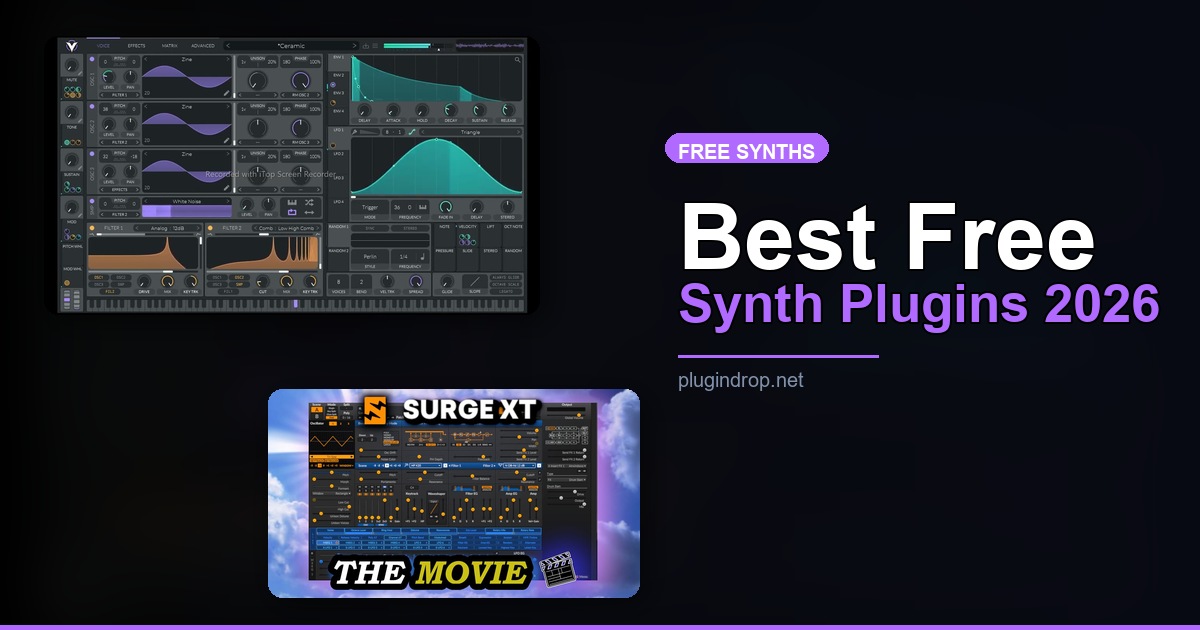
TL;DR: Vital is the best free wavetable synth VST available in 2026 — its full synthesis engine is completely free and rivals Serum in depth. Pair it with Surge XT for patches that need hybrid oscillator complexity, and you have a complete free wavetable toolkit before spending a cent.
Quick Picks at a Glance
| Plugin | Price | Best For | Get It |
|---|---|---|---|
| Vital | Free | Spectral wavetable leads, basses, evolving pads | Free Download |
| Surge XT | Free | Complex hybrid patches, deep modulation routing | Free Download |
| Odin 2 | Free | Wavetable + FM hybrid sounds, cinematic textures | Free Download |
| Zebralette | Free | Spectral morphing, u-he-quality timbres at no cost | Free Download |
| Helm | Free | Learning wavetable synthesis fundamentals | Free Download |
| Serum | ~$189 | Industry-standard wavetable, professional ecosystem | Get Serum |
| Phase Plant | ~$99 | Modular wavetable design, Snapins integration | Get Phase Plant |
| u-he Hive 2 | ~$99 | u-he quality in a fast, production-ready instrument | Get u-he Hive 2 |
Introduction
Here is the anomaly worth understanding before buying a single wavetable synth in 2026: the free tier of Vital includes the same synthesis engine as its paid tiers. No oscillator cap. No effects removed. No watermark on the output. The paid upgrades add presets and wavetables to the library — they do not unlock synthesis features. This is why the best free wavetable synth VST 2026 conversation always starts and largely ends with Vital, and why producers who purchased Serum before Vital existed now have a legitimate question about whether that $189 was strictly necessary.
Wavetable synthesis is the dominant architecture behind modern electronic production. The bright supersaw leads, morphing ambient pads, and punchy hybrid basses that define contemporary EDM, lo-fi, hyperpop, and film scoring are largely products of this synthesis paradigm — which cycles through stored waveforms and interpolates between them in real time. Free tools at this level represent a genuine shift in what a bedroom producer can build without financial commitment.
This guide covers five free wavetable VST plugins worth installing in 2026, ranked by depth and community standing, plus three paid instruments that justify the upgrade cost. It is written for producers who already understand basic synthesis concepts — if you know what an oscillator, envelope, and modulation source are, you are the target reader.
Best Free Wavetable Synth VST Plugins in 2026
Vital — The Free Benchmark
- Developer: Vital Audio (Matt Tytel)
- Price: Free (Vital Plus and Vital Pro tiers available for expanded preset and wavetable libraries)
- Platforms: Windows, macOS, Linux
- Formats: VST3, AU, AAX, Standalone
Vital offers three spectral morphing wavetable oscillators, a live visual oscilloscope display, and a drag-and-drop modulation matrix where any modulatable parameter can be assigned directly on the interface. The complete effects chain — distortion, chorus, flanger, phaser, reverb, delay, and filter — is included in the free tier. Developer documentation at vital.audio confirms 32-voice polyphony and full custom wavetable importing throughout all tiers.
Reddit’s r/edmproduction has documented Vital consistently in “Serum alternative” threads since its release, with community consensus placing its synthesis depth in the same tier as Serum for most production tasks. The free tier’s practical constraint is library size — fewer presets and wavetables ship with the free version, but the synthesis engine is uncapped. The wavetable editor supports spectral harmonic editing and custom waveform imports.
For producers who work heavily with third-party or user-designed wavetables, Vital Plus or Pro adds meaningful library depth. For everyone else, the free tier handles professional-level sound design without compromise.
Best for: Any producer who wants a professional-grade wavetable synth at zero cost — this is the first install.
Surge XT — Open-Source Depth
- Developer: Surge Synth Team (open source, GPL-licensed)
- Price: Free
- Platforms: Windows, macOS, Linux
- Formats: VST3, AU, AAX, CLAP, LV2, Standalone
Surge XT began as a commercial product before being open-sourced, and that development history shows in its architecture. The oscillator section supports eight types — Wavetable, Window, Modern, Classic, String, Twist, Alias, and S&H Noise — giving it hybrid synthesis capabilities that single-paradigm instruments cannot match. Developer documentation lists over 4,000 factory patches organized across electronic, cinematic, and experimental categories.
The modulation matrix is Surge XT’s most distinctive feature: any modulatable parameter can receive input from multiple simultaneous sources — LFOs, envelopes, MIDI, macros — using a matrix-style routing system rather than a fixed drag-and-drop interface. KVR’s Surge XT discussion threads are among the longest active plugin forums on the platform, reflecting sustained community investment rather than passive adoption.
Surge XT has a steeper learning curve than Vital. The depth is present, but the interface rewards producers who invest time. For producers who already understand modulation routing and want capability that exceeds several paid synths, it is one of the strongest free instruments available in any synthesis category.
Best for: Complex sound design, modulation-heavy patches, and experimental synthesis where fixed oscillator architectures create constraints.
Odin 2 — Wavetable and FM Under One Roof
- Developer: The Audio Programmer
- Price: Free (open source)
- Platforms: Windows, macOS
- Formats: VST3, AU
Odin 2 is an open-source polyphonic synthesizer that places wavetable, FM, and analog-modeled oscillator types under the same roof. Each of its three oscillator slots can be independently assigned to any oscillator type — meaning a single patch can combine a wavetable lead, an FM bell layer, and an analog-modeled sub simultaneously. That combination typically requires multiple instruments in a standard free plugin stack. Community discussion on r/synthesizers describes it as one of the more underrated free instruments in the wavetable category, consistently overlooked relative to Vital despite its capabilities.
The filter section offers multiple modes, and a built-in effects chain handles standard processing. The interface is more approachable than Surge XT while offering broader synthesis range than Vital’s focused wavetable identity. Odin 2 sits in the practical middle: multi-paradigm synthesis without demanding the time investment Surge XT requires.
Best for: Hybrid wavetable-FM patches and producers who need synthesis variety beyond a single oscillator paradigm without a steep learning curve.
Zebralette — u-he Quality, No Purchase Required
- Developer: u-he
- Price: Free
- Platforms: Windows, macOS
- Formats: VST2, VST3, AU
Zebralette is u-he’s free single-oscillator synthesizer, built directly around the spectral wavetable oscillator technology inside their flagship Zebra2. It is not a demo or stripped version — it is a maintained, fully functional instrument. The spectral approach here differs from how Vital or Surge XT handle waveforms: Zebralette generates sound through harmonic spectral data rather than standard sampled waveforms. KVR’s community consistently describes the output character as more “organic” and “analog-adjacent” compared to the brighter typical tonality of Vital — a distinction that matters for pad design and textural sound work.
The one-oscillator limitation is real. Layering complex polyphonic sounds requires more routing effort than a three-oscillator instrument. But for spectral pad design, atmospheric textures, and leads where timbral character matters more than feature count, Zebralette delivers results that producer forums routinely compare favorably to paid alternatives. u-he maintains it alongside their full commercial catalog, which means update reliability and cross-platform compatibility are consistent.
Best for: Spectral texture design and producers who want u-he’s sonic character as a free entry point before committing to Zebra2 or Hive 2.
Helm — Learn Before You Graduate
- Developer: Matt Tytel (same developer as Vital)
- Price: Free (open source)
- Platforms: Windows, macOS, Linux
- Formats: VST, AU, LV2, Standalone
Helm predates Vital and now occupies a specific niche: it is the right free wavetable synth for producers still building synthesis fundamentals. Its two-oscillator architecture, simpler modulation routing, and reduced effects chain create a more transparent signal path than Vital’s comprehensive interface. Reddit’s r/synthesizers threads regularly cite Helm as a “learn-before-you-graduate” option — fewer parameters make cause-and-effect relationships easier to isolate during the learning process.
Development has slowed significantly since Vital launched. The preset library is small, and for active music production, there is no reason to prefer Helm over Vital. The constraint that limits Helm as a production tool is exactly what makes it effective as a teaching instrument.
Best for: Producers new to wavetable synthesis who want a simplified architecture before moving to Vital’s deeper interface.
Worth Upgrading To (Paid Options)
Serum — The Industry Standard
- Developer: Xfer Records (Steve Duda)
- Price: ~$189 one-time (rent-to-own available via Splice)
- Why upgrade: Vital’s free tier handles the synthesis tasks that Serum handles, but Serum’s third-party preset and wavetable ecosystem has been built over years of industry deployment. If you work with major electronic music sound packs, collaborate with other producers on patches, or deliver client work where preset compatibility matters, Serum remains the default standard that those assets are designed around. The synthesis engines are comparable — the ecosystem is not.
Phase Plant — Modular Wavetable Architecture
- Developer: Kilohearts
- Price: ~$99
- Why upgrade: Vital and Surge XT are fixed-architecture instruments. Phase Plant lets you build synthesis chains from components — wavetable oscillators, sample playback, FM operators, noise generators — combined with Kilohearts’ “Snapin” effects system in a single patch. Reddit’s r/synthesizers community frequently identifies Phase Plant as the logical step for producers who have internalized conventional wavetable concepts and want to remove architecture constraints from their sound design process.
u-he Hive 2 — Fast, Professional-Grade Workflow
- Developer: u-he
- Price: ~$99
- Why upgrade: Zebralette delivers one oscillator from the u-he ecosystem. Hive 2 provides a complete two-oscillator wavetable/virtual-analog hybrid instrument designed explicitly for fast patch creation in live and studio contexts. Producers who rely on Zebralette and want the full u-he character in a production-ready instrument — without the depth investment required by Zebra2 — consistently identify Hive 2 as the right paid entry point into u-he’s catalog.
Full Comparison Table
| Plugin | Price | Type | Highlights | CTA |
|---|---|---|---|---|
| Vital | Free | Spectral wavetable | 3 oscillators, drag-drop modulation, full effects chain, 32-voice poly | Download |
| Surge XT | Free | Hybrid (8 oscillator types) | 4,000+ patches, matrix modulation routing, open source | Download |
| Odin 2 | Free | Wavetable + FM hybrid | 3 independent oscillator slots, 3 filters, open source | Download |
| Zebralette | Free | Spectral wavetable | u-he spectral oscillator tech, organic tonal character | Download |
| Helm | Free | Wavetable | Simple 2-oscillator architecture, ideal for learning | Download |
| Serum | ~$189 | Wavetable | Industry standard, massive third-party preset/wavetable library | Get it |
| Phase Plant | ~$99 | Modular wavetable | Component-based architecture, Snapins integration | Get it |
| u-he Hive 2 | ~$99 | Wavetable/analog hybrid | u-he quality, designed for fast studio workflow | Get it |
How to Choose
- If you need one free synth that covers everything: Vital. Its synthesis engine, modulation system, and effects chain make it the default install for any producer at any level.
- If you do complex, modulation-heavy sound design: Surge XT. Its eight oscillator types and matrix routing cover territory Vital’s fixed architecture doesn’t reach, particularly for hybrid and experimental synthesis.
- If you want wavetable and FM in a single free instrument: Odin 2. Its multi-paradigm oscillator assignment handles timbral territory that pure wavetable engines struggle with.
- If you want u-he’s sonic character at no cost: Zebralette. It delivers the spectral oscillator technology behind Zebra2 and functions as a direct gateway into u-he’s paid catalog.
- If you’re new to synthesis and Vital’s interface feels overwhelming: Helm. Its two-oscillator signal path makes modulation routing more transparent during the learning phase.
- If your workflow involves preset sharing, collaboration, or professional client work: Serum. The third-party ecosystem is the reason to buy it — not its synthesis engine relative to Vital’s free tier.
FAQ
Is Vital’s free tier actually complete, or is it limited in some way?
Developer documentation at vital.audio confirms the free tier includes the full synthesis engine — all three oscillators, the complete modulation matrix, the wavetable editor, and the built-in effects chain. The paid tiers (Vital Plus and Vital Pro) add expanded preset and wavetable libraries. No synthesis functionality is paywalled.
What is the practical difference between Vital and Serum?
Both are wavetable synthesizers with comparable interface architectures — visual oscilloscope, drag-and-drop modulation, built-in effects. Serum’s primary advantages are its larger third-party ecosystem (preset packs, wavetable libraries widely available commercially) and its position as the production standard that those assets are built to target. Reddit’s r/edmproduction has documented this comparison extensively — the consistent community position is that Vital handles most production use cases without requiring a Serum purchase. The case for Serum is its ecosystem, not a meaningful synthesis engine advantage.
Is Surge XT worth learning if I already use Vital?
For producers focused on hybrid synthesis, complex modulation routing, or experimental sound design: yes. Surge XT’s eight oscillator types and matrix modulation system offer capabilities Vital’s fixed architecture doesn’t provide. For standard electronic production using conventional wavetable sounds, Vital is sufficient and the Surge XT time investment isn’t necessary.
Can I use these plugins in any major DAW?
Vital, Surge XT, and Odin 2 support VST3 and AU, covering Ableton Live, FL Studio, Logic Pro, Reaper, Cubase, Studio One, and most major DAWs. Helm supports VST and AU. Zebralette supports VST2, VST3, and AU. Vital and Surge XT both confirm AAX support for Pro Tools workflows.
Should I buy Serum if I already have Vital?
Only if you work with commercial sound packs built specifically for Serum, collaborate with producers who share Serum patches, or need compatibility with client-supplied presets. For independent production, Vital covers the same synthesis tasks. The purchase case is the ecosystem — not what the synthesis engine does that Vital’s free tier cannot.
Related Guides
- 14 Best Free Synth VST Plugins in 2026 (Wavetable, FM, Analog)
- Complete Drum Mixing Plugin Chain: Best Tools for Punchy Drums (2026)
- Valhalla Room vs VintageVerb: Which Reverb Is Right for You?
- Valhalla VintageVerb Review: The $50 Reverb That Beats Plugins 10x Its Price
- 12 Best Free Compressor VST Plugins in 2026 (Every Style Covered)
Final Thoughts
For most producers, Vital is the only free wavetable synth that needs to be installed — its engine is complete, uncapped, and capable of professional-level sound design without any financial commitment. When your workflow demands the third-party preset ecosystem or professional collaboration standard that comes with market adoption, Serum remains the benchmark upgrade worth the cost.
This post contains affiliate links. We may earn a small commission at no extra cost to you.
This post contains affiliate links. We may earn a small commission at no extra cost to you.