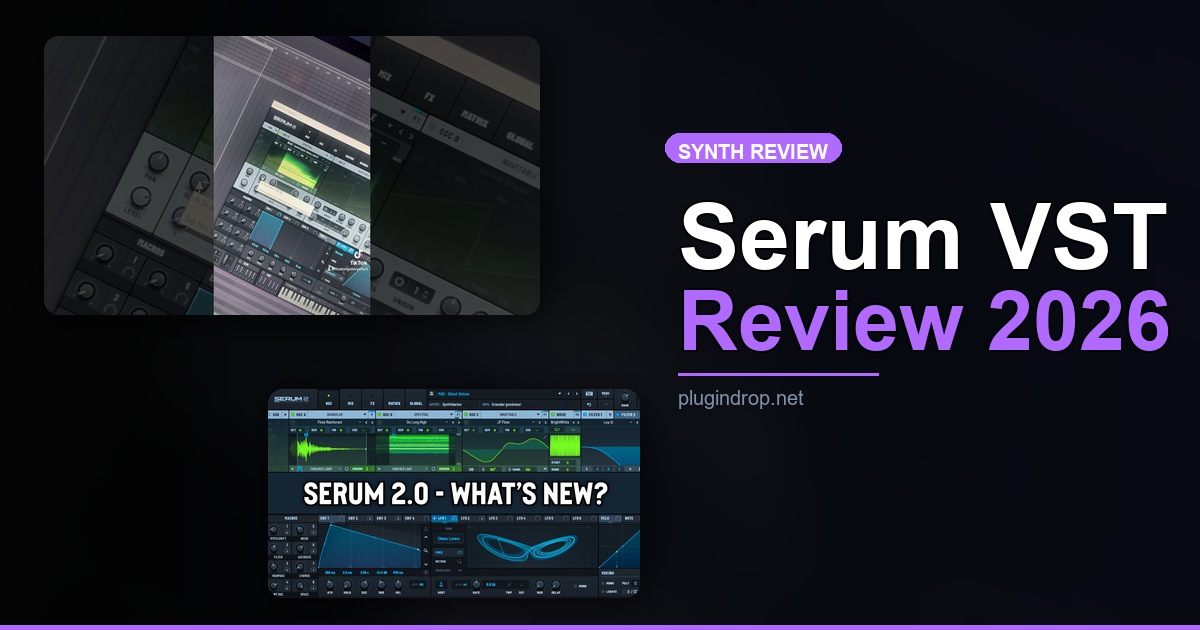
Xfer Serum Review 2026: Still the Best Wavetable Synth?
TL;DR: Xfer Serum remains the gold standard for wavetable synthesis in 2026 — its visual workflow, deep modulation system, and production-ready sound engine are unmatched for the price. If you produce any form of electronic music and don’t already own it, this is the plugin you buy first.
Quick Picks at a Glance
| Plugin | Price | Best For | Get It |
|---|---|---|---|
| Serum (Xfer Records) | ~$189 | All-around wavetable synthesis | Plugin Boutique |
| Phase Plant | ~$199 | Modular-style sound design | Plugin Boutique |
| Vital | Free / Paid | Budget Serum alternative | Plugin Boutique |
Introduction
If you’ve searched Serum VST review 2026 and landed here, you’re probably asking the same question thousands of producers ask every year: does Xfer Serum still hold up against a new wave of challengers? The short answer is yes — emphatically. But the longer answer is worth understanding before you spend $189.
Serum launched in 2014 and immediately became the benchmark wavetable synthesizer for a generation of electronic music producers. From festival-headlining dubstep to chart-topping pop leads, its fingerprints are everywhere. In 2026, the competitive landscape has evolved. Vital offers a compelling free alternative. Phase Plant appeals to modular thinkers. Serum 2 has been teased. Yet the original still dominates plugin sales charts and production tutorials alike.
This review covers everything you need to know: what Serum does, how it sounds, who it’s built for, how it stacks up against modern alternatives, and whether it’s still worth the investment in 2026. No filler. Just the information that helps you decide.
Core Review: Xfer Serum
Serum — The Wavetable Synth That Defined a Generation
- Developer: Xfer Records (Steve Duda)
- Price: ~$189 (one-time purchase)
- Platforms: Windows, macOS
- Formats: VST2, VST3, AU, AAX
Serum’s genius has always been the marriage of visual feedback and deep functionality. Every modulation connection, every oscillator warp, every filter sweep is rendered on screen in real time — which sounds cosmetic until you realize it fundamentally changes how quickly you can learn synthesis. Beginners grasp concepts in hours that would take weeks on a traditional synth.
Oscillator Engine
Two primary wavetable oscillators sit at the core, each capable of loading custom wavetables or using Serum’s extensive built-in library. The wavetable editor is where Serum genuinely separates itself from competitors — you can import audio, draw waveforms by hand, or use FFT analysis to extract wavetable content from any sample. In 2026, this workflow still feels ahead of the curve.
Unison stacking goes up to 16 voices per oscillator with per-voice detuning, pitch, and pan controls. Stack two fully detuned oscillators, add Serum’s sub-oscillator and noise source, and you’re already at sounds that would take multiple instruments in any analog workflow. The density is staggering.
Filter Section
Serum ships with over 100 filter modes — from clean ladder and Moog-style emulations to comb filters, vowel formants, and experimental ring-mod options. The drive character on the analog-modeled filters is warm and punchy without the CPU overhead you’d expect. Routing options let you pass oscillators to separate filter paths or blend them together, opening up complex timbral possibilities that most synths at this price don’t offer.
Modulation Matrix
This is where many competitors still fall short. Drag any modulation source — LFO, envelope, macro, MIDI, velocity — directly onto any parameter. The visual arc shows the modulation range on the knob itself. Four macro controls can each control dozens of parameters simultaneously, making Serum a natural fit for expressive live performance and sound design with depth you can re-open months later and immediately understand.
The LFO editor supports custom shapes drawn freehand or loaded as wavetables, meaning your modulation sources can be as complex as your oscillators. That’s a design philosophy that keeps Serum relevant even as its interface shows its age aesthetically.
Built-In Effects Chain
Nine effect slots with high-quality processors: Hyper/Dimension (chorus/ensemble), Distortion, Flanger, Phaser, Chorus, Delay, Reverb, EQ, Compressor, and Multiband Compressor. The Hyper effect alone — a pitch-microshifted unison effect — is responsible for an enormous percentage of modern synth textures. Having studio-quality effects baked in means you can bounce complete, polished sounds without a single third-party plugin in the chain.
Preset Library and Community Ecosystem
Serum’s preset ecosystem is arguably its most underrated feature in 2026. The community has produced tens of thousands of free and commercial preset packs over 12 years. Every major sound designer has a Serum pack. Every tutorial uses Serum. Every DAW comes with Serum demo projects. This network effect creates compounding value that new entrants simply cannot replicate regardless of their technical merits.
Performance and CPU
On modern hardware, Serum performs well. It has never been a light synth — running 16-voice unison with full effects will stress a CPU. But in 2026, with typical production machines running M-series chips or high-core-count PC processors, Serum’s CPU load is rarely a practical bottleneck. Freeze tracks if you need headroom. The quality justifies the cost.
What Serum Doesn’t Do Well
Serum’s interface is not resizable beyond a fixed scale — a genuine irritant on high-DPI displays. Its modular routing is less flexible than Phase Plant’s open-ended node system. For FM synthesis enthusiasts, Serum’s FM options (oscillator B can modulate oscillator A) are capable but not the focus of the instrument. And there’s no granular engine built in. For producers with very specific workflow needs, these gaps matter.
Best for: Electronic music producers of all levels who want one instrument that can cover the full range of modern synthesis sounds — leads, basses, pads, plucks, FX, and everything in between.
→ Get Serum on Plugin Boutique
Worth Upgrading To (Paid Options)
For producers who’ve evaluated Serum and want to understand the wider landscape — or who are building out a synthesis toolkit beyond their first major purchase — these two instruments are the most credible alternatives and complements.
Phase Plant — Best for Modular-Minded Sound Designers
- Developer: Kilohearts
- Price: ~$199
- Why consider it alongside Serum: Phase Plant uses a node-based modular architecture that gives you total routing freedom — wavetable, sample, analog, and FM sources can be combined in ways Serum’s fixed signal path doesn’t allow. It’s a different paradigm, not a better or worse one.
Phase Plant rewards the producer who has already learned synthesis fundamentals and wants to push into complex, layered sound design without a hardware modular. Its integration with the Kilohearts Toolbox of Snapin effects is genuinely powerful for creating complete sounds internally.
→ Get Phase Plant on Plugin Boutique
Vital — Best Free Serum Alternative, Expandable via Paid Tier
- Developer: Matt Tytel
- Price: Free / Paid tiers from ~$25+
- Why consider it: Vital’s free tier is the most complete free wavetable synth available in 2026 — it covers roughly 80% of Serum’s functionality at zero cost, with a similarly visual interface and strong preset community. The paid tiers unlock additional wavetables and presets.
For producers on a strict budget, Vital is where to start. For producers ready to invest in their toolkit, it’s worth comparing directly against Serum before deciding. The quality gap is real but narrower than it was at launch.
→ Get Vital on Plugin Boutique
Full Comparison Table
| Plugin | Price | Type | Highlights | CTA |
|---|---|---|---|---|
| Serum | ~$189 | Wavetable | Custom wavetable editor, drag-and-drop modulation, 100+ filters, built-in FX | Plugin Boutique |
| Phase Plant | ~$199 | Modular / Multi-engine | Node-based routing, wavetable + FM + analog sources, Snapin effects integration | Plugin Boutique |
| Vital | Free / Paid | Wavetable | Free tier covers core features, strong community, visual modulation | Plugin Boutique |
How to Choose
-
If you produce EDM, dubstep, future bass, or pop and want the industry standard: Get Serum. Full stop. The community resources, tutorials, and preset ecosystem justify the purchase on their own, before you even consider the quality of the instrument itself.
-
If budget is the primary constraint: Start with Vital’s free tier. It will teach you wavetable synthesis properly and let you make professional-quality tracks. Upgrade to Serum when the gaps become friction in your actual workflow.
-
If you already own Serum and want to expand: Phase Plant complements Serum rather than replacing it — use Serum for quick, polished sound design and Phase Plant when you need a complex layered architecture the fixed-path workflow can’t achieve.
-
If you’re primarily a hardware synthesist looking for a software complement: Serum’s visual interface makes it one of the more intuitive bridges between analog hardware thinking and software synthesis. The filter emulations and noise options feel hardware-adjacent in a way that more “digital” designs don’t.
-
If you’re waiting for Serum 2: A reasonable position, but not a reason to avoid Serum 1 in the interim. The current version is fully supported, continuously updated, and will likely be part of whatever upgrade path Xfer Records offers. The risk of waiting is low; the cost of not having it is real.
FAQ
Is Serum worth buying in 2026? Yes. Its combination of sound quality, community resources, tutorial coverage, and preset availability makes it one of the highest-value instruments in electronic music production at any price point. Twelve years of community output is a compounding asset that newer instruments can’t match.
What’s the difference between Serum and Vital? Both are visual wavetable synthesizers with similar interfaces. Serum has a more refined filter section, a dedicated wavetable editor that allows audio import, and a more mature preset ecosystem. Vital offers a free tier that covers the fundamentals. Serum is the ceiling; Vital is an excellent starting point.
Can you use Serum in Ableton, FL Studio, and Logic? Yes. Serum supports VST2, VST3, AU, and AAX formats, covering compatibility with every major DAW on Windows and macOS. It runs natively on Apple Silicon without Rosetta translation.
Is Serum good for beginners? It’s one of the best learning tools for synthesis available precisely because of its visual approach. Every modulation connection and signal flow is visible on screen. Many producers cite Serum as the instrument that finally made synthesis concepts click.
Does Serum have a free trial? Xfer Records has offered a rental-to-own model via Splice in the past, which allowed producers to pay monthly toward the full purchase price. Check the developer site at xferrecords.com for current purchase and trial options.
Final Thoughts
Xfer Serum in 2026 is the rare piece of software that has aged into near-universality — not through lack of competition, but because its core design decisions have proven durable across a decade of shifting trends. It sounds exceptional, teaches synthesis visually, integrates with every DAW, and connects you to the largest community of presets, tutorials, and sound designers in electronic music. At ~$189, it remains one of the most defensible purchases in a producer’s plugin budget.
→ Get Serum on Plugin Boutique
This post contains affiliate links. We may earn a small commission at no extra cost to you.
Related Guides
- Best Synth Plugins 2026 — Ranked: Free & Paid VSTs for Every Style
- 14 Best Free Synth VST Plugins 2026 (Including Vital)
- Serum vs Vital: Free vs Paid Wavetable Comparison
- Phase Plant vs Serum: Which Wavetable Synth Wins?
- Best Synth VST Plugins 2026: Top Options Ranked
This post contains affiliate links. We may earn a small commission at no extra cost to you.