Phase Plant Review: The Most Flexible Synth for Sound Designers in 2026?
TL;DR: Phase Plant by Kilohearts is the most architecturally flexible synthesizer available today — a modular blank canvas where you stack generators, route modulators, and chain Snapin effects into virtually any synthesis style imaginable. It has a genuinely usable free tier (Phase Plant Essentials) and a full version that competes with synths costing twice as much. If you do serious sound design, nothing in 2026 comes close to its depth-per-dollar.
Quick Picks at a Glance
| Plugin | Price | Best For | Get It |
|---|---|---|---|
| Phase Plant (Free Tier) | Free | Exploring modular synthesis before committing | Free Download |
| Phase Plant (Full) | ~$199 | All synthesis styles, deep sound design | Official Site |
| Serum | ~$189 | Wavetable-focused EDM production | Official Site |
| u-he Hive 2 | ~$149 | Fast analog/wavetable workflow | Official Site |
Introduction
Here is the misconception that trips up most producers shopping for a new synth in 2026: they treat synthesis style as fixed — wavetable, FM, analog, granular — and shop accordingly. Phase Plant exposes that framing as outdated. Its generator-modulator-effects architecture lets you combine wavetable oscillators, FM operators, sample players, and noise sources inside a single patch, modulate anything with anything, and push the result through a Snapin effects chain — all within one instrument. The “Phase Plant Kilohearts review 2026” conversation in production communities keeps heating up because producers are finally realizing this isn’t just marketing flexibility; it’s a genuinely different paradigm.
That matters in 2026 because the sound design bar has risen. Audiences who grew up on Splice packs and template beats are harder to impress with off-the-shelf presets. The producers pulling ahead are building signature sounds by combining techniques that don’t fit inside a single-engine synth. Phase Plant’s architecture was built for exactly that kind of work.
This guide is a deep-dive review for sound designers, electronic producers, and composers who want to understand exactly what Phase Plant does, where it leads the market, and where Serum or Hive 2 might be a smarter choice for their workflow. Pricing references are approximate — verify current pricing at the official site before purchasing.
Phase Plant — Deep Dive Review
Phase Plant — The Most Modular Semi-Modular Synth in Its Class
- Developer: Kilohearts
- Price: Free tier available / Full version ~$199 (check site for current pricing)
- Platforms: Windows, macOS
- Formats: VST3, AU, AAX, Standalone
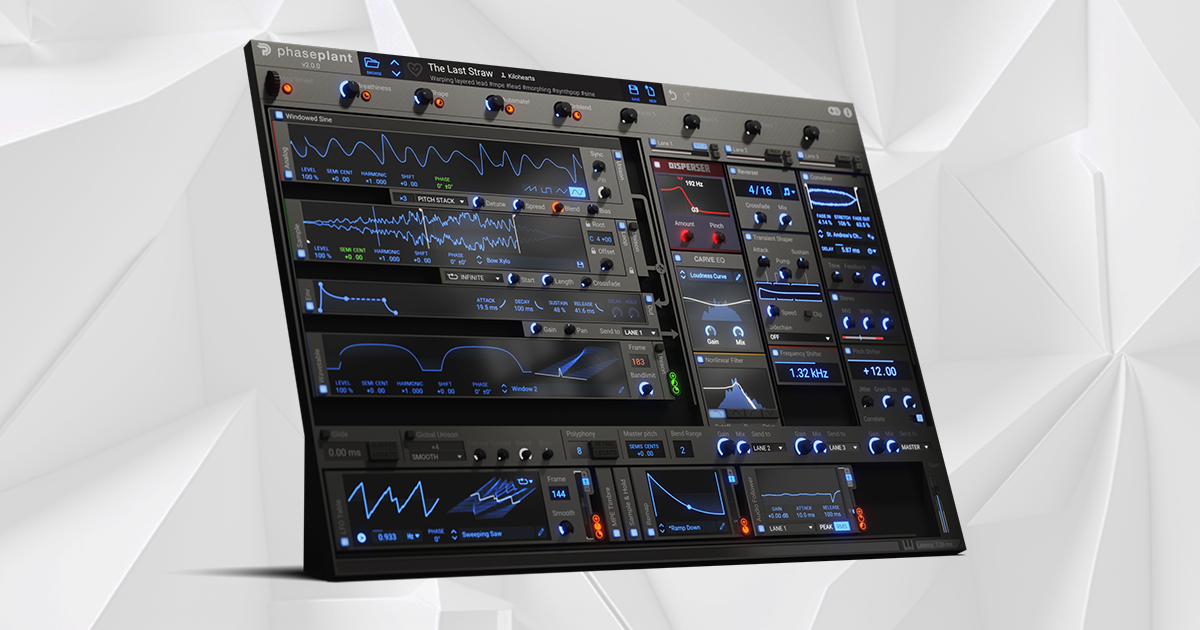
Phase Plant’s architecture is built around three horizontal lanes: Generators, Modulators, and an Effects chain. Generators produce sound. Modulators shape parameters. Effects process the output. What makes Phase Plant extraordinary is that none of these are locked to a fixed topology — you add as many as you need, in any combination, and modulation routing is accomplished by dragging a connection dot from any modulator to any knob in any generator or effect.
Generator types include an Analog oscillator (classic waveforms with PWM), a Wavetable oscillator (with custom wavetable import), a Sample player, a Super oscillator (stacked unison with detuning), and a Noise generator. You can run multiple generators in parallel, group them, and apply individual gain/panning per generator. Need FM synthesis? Route one oscillator’s output as a frequency modulator to another — that’s audio-rate modulation, not LFO-rate approximation.
Modulators cover all the expected bases: ADSR Envelopes with multiple curve shapes, LFOs with tempo sync and phase offset, Macro controls (automatable from your DAW), a Curve modulator for hand-drawn shapes, a Random (sample-and-hold) modulator, MIDI source modulators (velocity, note, pitch bend, aftertouch), and an Output modulator for audio-rate feedback routing. The depth of the modulation matrix is Phase Plant’s single biggest differentiator from fixed-architecture synths like Serum. Almost nothing is off-limits as a modulation destination.
The Snapin effects chain processes the final signal and is where Phase Plant integrates with the broader Kilohearts ecosystem. A solid set of Snapins comes bundled — filter, distortion, chorus, delay, and reverb among them — and additional Snapins from Kilohearts’ catalog (Snap Heap, Multipass) can be dropped in. This isn’t an afterthought effects bus; it’s a fully modular signal processor where each Snapin’s parameters are also available as modulation targets.
Best for: Sound designers who need cross-style synthesis in one instrument — scoring, electronic music, film sound, experimental production.
→ Get Phase Plant on Official Site
The Free Tier — Genuine Value or Just a Taste?
Kilohearts offers Phase Plant Essentials as a free download. It’s a real synth, not a 5-minute demo. The free tier gives you access to the core architecture: you can run multiple generators, use envelopes and LFOs, and work with the included Snapins. The limitations kick in when you need the full generator roster (Sample player and Super oscillator are paywalled) and when you want the extended Snapin library.
For producers evaluating whether to spend $199, this is an unusually honest trial. You can build real sounds, export audio, and decide based on actual usage. Most competing synths give you either a time-limited demo or a crippled export. Phase Plant Essentials is neither.
Workflow and Interface — High Ceiling, Steep Ramp
The interface is clean by modular standards. Generators and modulators are laid out left-to-right, the effects chain sits below, and routing connections are color-coded. After a few sessions, the layout becomes intuitive. The challenge isn’t the interface — it’s the open-ended decision-making. When a synth can be anything, deciding what to make it can cause paralysis for producers used to fixed architectures.
Kilohearts partially addresses this with a strong preset library. The factory presets are genuinely usable, not just tech demos, and they cover cinematic pads, aggressive basses, plucks, leads, and textural content. More importantly, they’re built in a way that rewards reverse-engineering — you can open any preset, see the exact generator/modulator/effects stack, and understand how to recreate or modify it. The presets function as a built-in tutorial system.
CPU usage scales with patch complexity. A simple two-oscillator patch is light. A six-generator FM patch with multiple audio-rate modulators and a dense Snapin chain will tax your CPU. On modern hardware (M-series Mac, AMD Ryzen 7+) this is a non-issue for most use cases, but low-spec machines should test complex patches before committing to high polyphony counts.
Who Should Buy Phase Plant
Phase Plant makes the most sense for:
- Film/TV composers who need one synth that can cover organic textures, sci-fi design, and hybrid orchestral elements without switching instruments
- Electronic producers working across multiple genres who want a consistent creative environment
- Sound designers building complex, layered patches where standard synths run out of routing options
- Producers learning synthesis who want to understand signal flow at a structural level — the visual architecture is genuinely educational
It’s less ideal for producers who need a fast preset-browser workflow and minimal menu-diving. If you’re dropping a preset bass on a beat and moving on, Phase Plant’s flexibility is overhead you won’t use.
Worth Upgrading To (Paid Options)
Serum — The Wavetable Benchmark, Still Earning Its Reputation
- Developer: Xfer Records
- Price: ~$189 (perpetual license or Splice subscription)
- Why upgrade: If your production style lives in wavetable synthesis — EDM, future bass, pop, trap — Serum’s dedicated wavetable editor, visual modulation display, and massive preset ecosystem give you a faster, more community-supported workflow than Phase Plant’s more generalist approach. Phase Plant can match Serum’s wavetable output technically, but Serum’s purpose-built interface gets you there in half the clicks.
u-he Hive 2 — The Fast-Workflow Hybrid for Working Producers
- Developer: u-he
- Price: ~$149
- Why upgrade: Hive 2 is engineered for speed. Its analog/wavetable hybrid engine sounds excellent out of the box, its interface is stripped down to essential controls, and its preset library is among the best in the industry for immediate usability. If Phase Plant’s open-endedness feels like overhead and you want great sounds in 30 seconds rather than 30 minutes, Hive 2 is the smarter buy.
→ Get u-he Hive 2 on Official Site
Full Comparison Table
| Plugin | Price | Type | Highlights | CTA |
|---|---|---|---|---|
| Phase Plant (Free) | Free | Modular Semi-Modular | Multi-generator, Snapin effects, free tier | Get It |
| Phase Plant (Full) | ~$199 | Modular Semi-Modular | Full generator roster, audio-rate mod, Snapin ecosystem | Get It |
| Serum | ~$189 | Wavetable | Wavetable editor, visual modulation, preset community | Get It |
| u-he Hive 2 | ~$149 | Analog/Wavetable Hybrid | Fast workflow, polished presets, low CPU | Get It |
How to Choose
- If you need maximum synthesis flexibility across styles — Phase Plant full version is the only instrument that genuinely covers analog emulation, wavetable, FM, granular-adjacent, and sample-based synthesis in a single patch. Nothing else in the price range matches it.
- If you produce EDM, future bass, or pop and live in wavetable territory — Serum’s dedicated workflow and massive preset ecosystem will make you faster than Phase Plant’s generalist approach.
- If you want excellent sounds immediately with minimal menu-diving — u-he Hive 2’s preset library and streamlined interface make it the most productive choice for working producers on deadline.
- If you’re new to synthesis and want to learn how it actually works — Start with Phase Plant Essentials (free) before spending anything. Its visual architecture is the best self-teaching tool in the market.
- If you’re already in the Kilohearts ecosystem (using Snap Heap, Disperser, Transient Shaper as Snapins) — Phase Plant full version is a no-brainer upgrade; the Snapin integration makes the investment worthwhile.
FAQ
Is Phase Plant good for beginners? Phase Plant Essentials is genuinely useful for beginners specifically because its architecture is visual and explicit — you see exactly what every modulator is doing. The learning curve is about synthesis concepts, not the interface. That said, producers who want usable sounds fast without learning theory may find Hive 2 more accessible.
Can Phase Plant do FM synthesis? Yes — you can route an oscillator’s output as a frequency modulation source to another oscillator using the Output modulator. This is true audio-rate FM, not a workaround. It’s not as deep as a dedicated FM synth like FM8, but it’s more than capable for standard FM bass, bell, and metallic textures.
Does Phase Plant come with a good preset library? The factory preset library is solid and genuinely usable across cinematic, electronic, and experimental styles. The presets are also well-built for reverse engineering — opening them is an effective way to learn advanced Phase Plant techniques.
How does Phase Plant compare to Serum in 2026? Serum is purpose-built for wavetable synthesis with a faster, more focused workflow. Phase Plant is broader — it includes a wavetable engine alongside analog, FM, sample, and noise generators in one instrument. For wavetable-centric work, Serum’s dedicated editor and community ecosystem give it an edge. For cross-genre sound design, Phase Plant wins on flexibility.
What are Kilohearts Snapins and do I need to buy them separately? Snapins are Kilohearts’ modular effects format, compatible with Phase Plant, Snap Heap, and Multipass. Phase Plant ships with a core set of Snapins included. Additional Snapins (more advanced reverb, multiband effects, etc.) are sold separately or bundled via the Kilohearts subscription. The included set covers most production needs; the upsells are for advanced users who are already in the ecosystem.
Related Guides
- 14 Best Free Synth VST Plugins 2026
- Phase Plant vs Serum: Which Wavetable Synth Wins?
- Serum VST Review 2026
- Best Synth VST Plugins 2026
- Is Serum Worth It in 2026?
This post contains affiliate links. We may earn a small commission at no extra cost to you.